
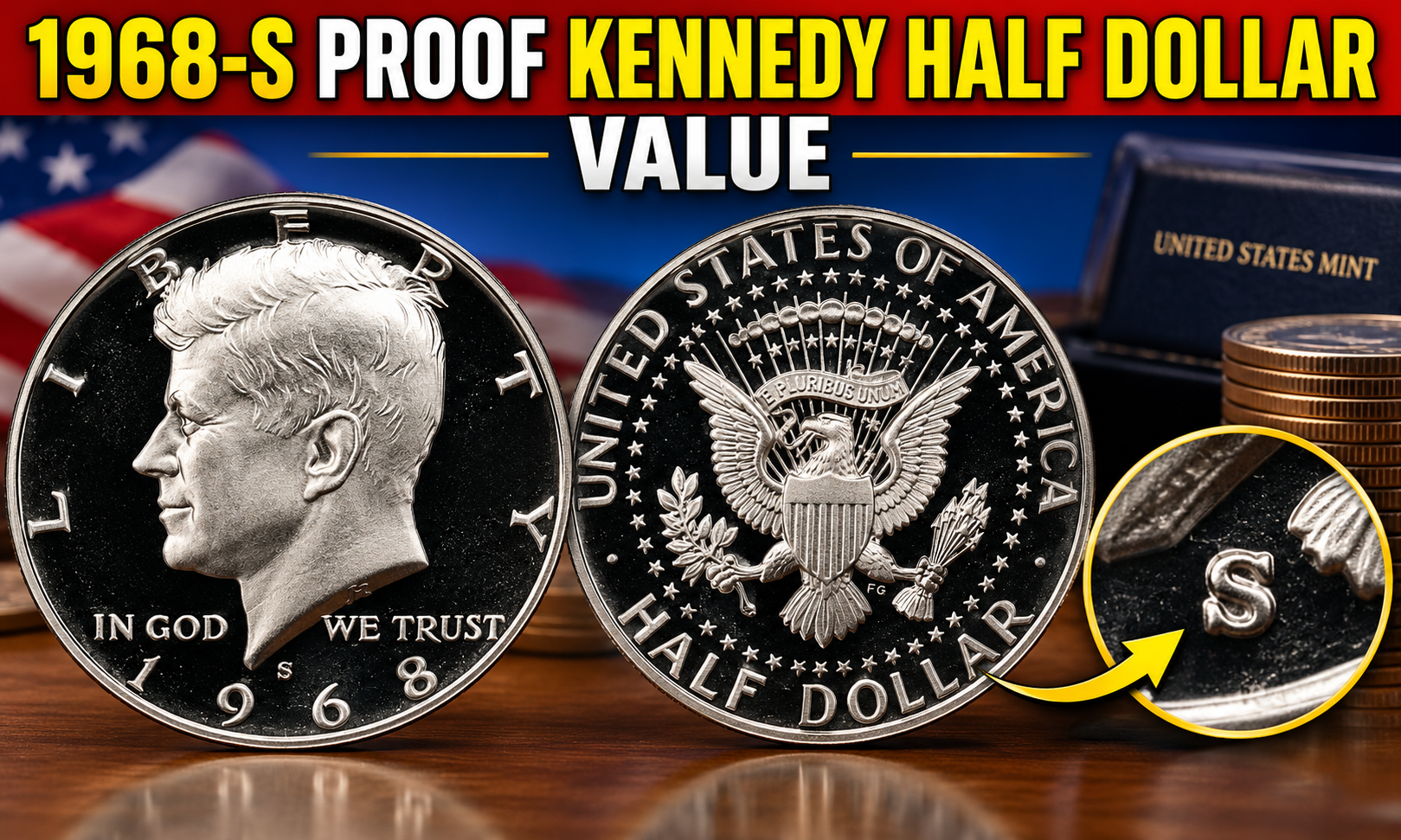
You open an old 1968 proof set and see a shiny half dollar with a tiny “S” mint mark. Is it just pocket change, or a hidden gem?
The 1968-S proof Kennedy half dollar value surprises many collectors. Most coins are modest, but a few are worth real money. Therefore, grading decisions matter a lot.
In this guide, you will learn what your coin is worth, what drives its price, and when grading pays off.
Table of Contents
- Quick answer: how much is it worth?
- Key facts about the 1968-S proof half
- Value by grade
- What makes one coin worth more?
- Is it worth grading?
- Why it matters
- Key takeaways
- FAQs
- Conclusion
Quick Answer: What Is the 1968-S Proof Kennedy Half Dollar Value?
Most raw 1968-S proof Kennedy halves sell for roughly $6 to $12, based on silver prices and condition. Graded PR69 deep cameo coins often bring a modest premium. Flawless PR70 examples are rare and can sell for far more.
Prices change often, so always check a current price guide before selling.
Key Facts About the 1968-S Proof Kennedy Half
The 1968-S proof is special for a few reasons. First, it came from the San Francisco Mint. Second, it was sold only in official proof sets.
- Mintage: about 3 million proof coins
- Composition: 40% silver, 60% copper
- Silver content: roughly 0.148 troy ounces of pure silver
- Designer: Gilroy Roberts (obverse) and Frank Gasparro (reverse)
- Mint mark: “S” below the wreath on the reverse
Proof coins were not made for circulation between 1965 and 1967. As a result, the 1968 proof set marked the return of true proof coinage after a gap. That history adds some collector appeal.
You can read more about the series on Wikipedia’s Kennedy half dollar page.
1968-S Proof Kennedy Half Dollar Value by Grade
Value depends mostly on condition and surface quality. Here are rough ranges, which move with the market.
- Raw, in original set: about $6 to $12
- PR66 to PR67: about $8 to $15
- PR68 to PR69 (cameo or deep cameo): often $15 to $40
- PR70 deep cameo: rare, and prices can climb into the hundreds or higher
Treat these figures as estimates. Check PCGS CoinFacts or recent sold listings for current numbers.
What Makes One Coin Worth More?
Several factors push a 1968-S proof Kennedy half dollar value higher. However, most coins from sets have none of them.
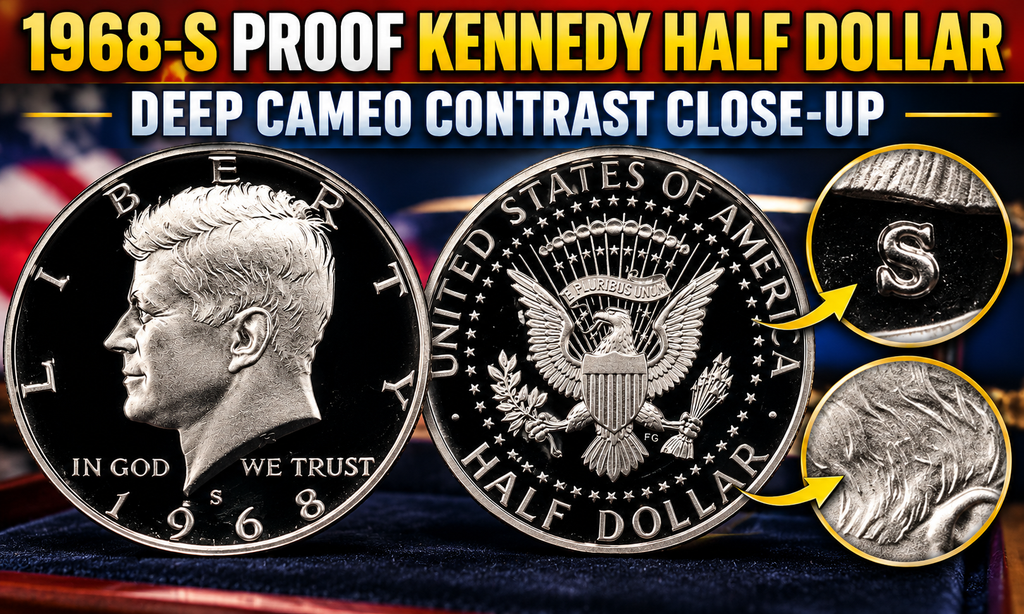
Cameo and Deep Cameo Contrast
Proofs have frosted designs against mirror-like fields. Strong contrast earns a “Cameo” or “Deep Cameo” label. These labels can double or triple a coin’s price.
Surface Quality
Hairlines, spots, and fingerprints hurt value. Because proof surfaces are delicate, many coins have flaws. Clean, spot-free coins are the ones that pay off.
Silver Content
Your coin holds about 0.148 ounces of silver. So its melt value rises when silver prices rise. This acts as a price floor for lower-grade coins.
Toning
Attractive rainbow toning can add a premium. Ugly brown or black spotting does the opposite. Never clean a proof coin, because cleaning destroys its value.
Is It Worth Grading Your 1968-S Proof Kennedy Half?
Grading costs money, so the math matters. Services like PCGS and NGC often charge around $20 to $40 per coin, plus shipping and insurance. Prices vary by service level.
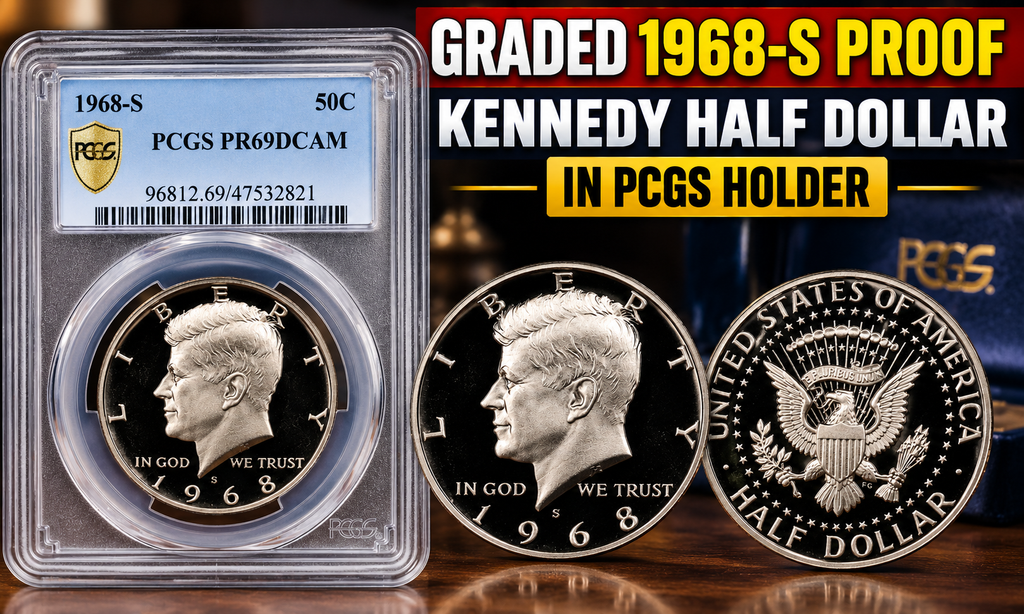
Because common 1968-S proofs sell for under $15, grading usually loses money. However, a few coins deserve a second look.
Grade it if the coin:
- Has deep, bold frost against mirrored fields
- Shows no visible spots, scratches, or hairlines
- Looks flawless under 5x magnification
- Sits in its original, unopened government packaging
Skip grading if the coin:
- Has fingerprints, haze, or milky spots
- Shows hairlines or scratches
- Looks dull or cleaned
A smart middle path helps. Pick your best two or three coins and submit only those. Alternatively, try a bulk submission to lower the per-coin fee.
Why It Matters
Many people sell proof halves for melt value without checking quality. That can be a mistake. One high-grade deep cameo coin can outsell dozens of ordinary ones.
On the other hand, paying for grading on average coins wastes money. Knowing the difference protects your wallet.
How to Check Your Coin Before Grading
Follow these steps to inspect your coin safely.
- Hold it by the edges only, using cotton gloves if possible.
- Check under bright, angled light.
- Look for spots, scratches, and haze.
- Compare the frost contrast to online grading photos.
- Compare recent sold prices for similar grades.
If the coin passes, consider grading. Otherwise, keep it in its set and enjoy it.
Key Takeaways
- The typical 1968-S proof Kennedy half dollar value is modest, around $6 to $12.
- The coin contains 40% silver, which sets a value floor.
- Deep cameo contrast and flawless surfaces drive premiums.
- Grade only your best, cleanest examples.
- Never clean your coin.
FAQs
1. Is the 1968-S Kennedy half dollar silver?
Yes, it is 40% silver. The coin contains roughly 0.148 troy ounces of pure silver, so it has real metal value.
2. How much is a 1968-S proof Kennedy half dollar worth?
Most sell for about $6 to $12. High-grade deep cameo coins bring more, and PR70 examples are rare.
3. Is the 1968-S proof Kennedy half dollar rare?
No. About 3 million were made, so ordinary examples are common. Only top-grade coins are scarce.
4. Should I grade my 1968-S proof Kennedy half?
Grade only coins with deep cameo contrast and flawless surfaces. Average coins rarely repay the fee.
5. Where can I sell my 1968-S proof Kennedy half dollar?
You can use local coin dealers, coin shows, or online marketplaces. Compare offers and check recent sold prices first.
Conclusion
The 1968-S proof Kennedy half dollar value is usually small, but the right coin can surprise you. Silver content gives a safe floor, and top-grade deep cameo coins offer upside.
Inspect your coin, skip grading for flawed pieces, and submit only your best. Smart choices keep costs low and profits higher.
Ready to check your coins? Pull out your proof sets today and inspect them. Then explore our related guides below and share your best finds in the comments.