
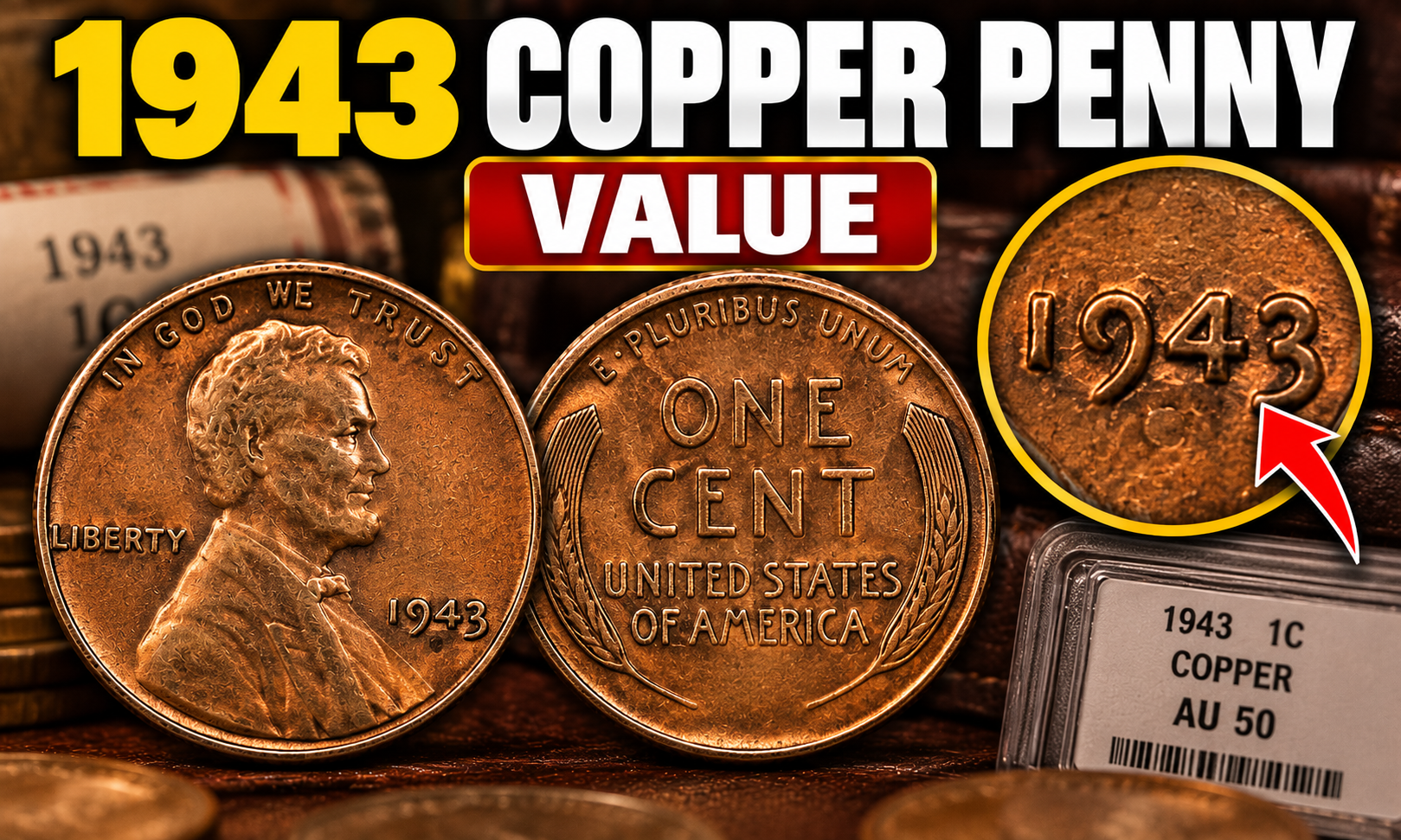
Imagine finding a million-dollar coin in your grandfather’s jar of loose change. It sounds like a fantasy. Yet it has happened, and the coin was a 1943 copper penny.
The 1943 copper penny value is among the highest in American coin collecting. However, most 1943 pennies you find are common steel coins worth only a few cents. Fakes are everywhere too.
This guide shows you what makes the real coin special. You will also learn simple tests to spot a genuine one.
Table of Contents
- What Is a 1943 Copper Penny?
- Quick Answer: Is Yours Real?
- 1943 Copper Penny Value by Mint Mark
- How to Spot a Real One (5 Tests)
- Common Fakes to Avoid
- What Your 1943 Steel Penny Is Worth
- Should You Get It Graded?
- FAQs and Conclusion
What Is a 1943 Copper Penny?
In 1943, the U.S. needed copper for the war effort. The metal went into shell casings and wire. Therefore, the Mint made pennies from zinc-coated steel that year.
However, a few copper blanks from 1942 stayed in the press hoppers. They were struck with the 1943 date by mistake. These are the true 1943 copper pennies, also called 1943 bronze cents.
Only a handful exist. Collectors believe they came from Philadelphia, Denver and San Francisco. That tiny supply explains the huge price tag.
Quick Answer: Is Your 1943 Penny Copper?
A genuine 1943 copper penny is brown or reddish, not silver-gray. It is not magnetic and weighs about 3.11 grams. Most 1943 pennies are steel, stick to a magnet and weigh about 2.7 grams. If yours is non-magnetic, have an expert authenticate it.
That short test filters out nearly every coin. Still, read on, because fakes can pass one test.
1943 Copper Penny Value by Mint Mark
The 1943 copper penny value depends on the mint mark and condition. The mint mark sits below the date.
- 1943 (no mint mark, Philadelphia): Auction sales have reached six figures and beyond.
- 1943-D (Denver): Only one is widely known. It sold for about $1.7 million in 2010.
- 1943-S (San Francisco): A handful exist. One sold for over $1 million at auction.
Prices change with the market and each coin’s grade. Treat these figures as rough guides, not promises. Always check recent auction results from a trusted house.
Why It Matters
Many people search “1943 penny value” and assume they have a treasure. Meanwhile, the real rarity is almost never found in pocket change. Knowing the difference saves you time, and it protects you from scams.
How to Spot a Real 1943 Copper Penny
Follow these five tests in order. Each takes only a minute.
1. Do the Magnet Test
Hold a magnet near the coin. A steel penny will stick. Copper will not.
Because of this, the magnet test is your first and best filter. If the coin sticks, it is a common steel cent.
2. Check the Color
A real copper cent looks brown, tan or reddish. Steel cents look silver-gray, or dull gray when worn.
However, color alone can fool you. Copper plating can make steel look brown.
3. Weigh the Coin
Use a scale accurate to 0.01 grams. A genuine bronze cent weighs about 3.11 grams. A steel cent weighs about 2.70 grams.
Therefore, a coin near 2.7 grams is steel, even if it looks copper. This catches most plated fakes.
4. Inspect the Date Closely
Use a magnifier. Look at the “3” in 1943. Some fakers alter the last digit of a 1948 cent. In that case, the “3” may look odd or misshapen. The 1948 mint mark position may also differ.
5. Get Expert Authentication
If your coin passes the first four tests, stop handling it. Send it to a major grading service such as PCGS or NGC. Their experts will authenticate and grade it.
Common 1943 Copper Penny Fakes
Counterfeits are the main risk. Here are the usual tricks:
- Altered dates: A 1948 penny changed to read 1943.
- Plated steel pennies: A steel cent coated in copper.
- Cast copies: Replicas that look right but weigh wrong.
- Fake mint marks: A “D” or “S” added to a plain coin.
Remember that scales and magnets expose most of these. Be careful if a seller refuses to let you test the coin. Also, never pay a high price without third-party certification.
What Is a 1943 Steel Penny Worth?
Don’t be discouraged if yours is steel. It is still a fun piece of wartime history.
- Circulated: About 10 to 50 cents.
- Uncirculated: A few dollars.
- High-grade graded coins: Can sell for much more.
Rusty or damaged steel cents are worth the least. However, clean, bright examples attract collectors. You can read more about this coin on Wikipedia’s page on the 1943 steel cent.
Should You Get Your Penny Graded?
Grading makes sense only if your coin passes the magnet and weight tests. Otherwise, the fee will cost more than the coin is worth.
Here is a simple rule of thumb:
- Non-magnetic and about 3.11 grams? Pursue authentication.
- Magnetic steel? Keep it as a collectible.
- Unsure? Ask a local coin dealer for a free opinion.
Never clean your coin. Cleaning can destroy its value in seconds.
Key Takeaways
- Most 1943 pennies are steel, not copper.
- A real copper one is non-magnetic and weighs about 3.11 grams.
- The 1943 copper penny value can exceed $1 million.
- Fakes include altered 1948 dates and plated steel cents.
- Always authenticate before you sell.
FAQs
1. How much is a 1943 copper penny worth?
A genuine one can be worth anywhere from six figures to over $1 million. The exact 1943 copper penny value depends on the mint mark and grade.
2. How can I tell if my 1943 penny is copper?
Use a magnet. Copper is not magnetic, but steel is. Then confirm with a weight of about 3.11 grams.
3. Why are 1943 pennies made of steel?
Copper was needed for World War II ammunition. The Mint switched to zinc-coated steel to save it.
4. Are 1943 steel pennies worth anything?
Yes, but only a little. Most sell for 10 to 50 cents, and nicer ones bring a few dollars.
5. How many 1943 copper pennies exist?
Only a small number are known, believed to be between 10 and 20. That rarity drives the high 1943 copper penny value.
Conclusion
The 1943 copper penny is one of the most famous coin errors in American history. Its value is real, but so are the fakes. Use the magnet test, weigh the coin, check the date and get expert authentication.
Ready to check your change? Grab a magnet and a scale today, then check your old coin jars. You might be holding something extraordinary. For more ideas on what to look for, keep exploring our guides below.