
Do you have an old Buffalo nickel sitting in a drawer — and no idea what it’s actually worth? You’re not alone. These coins look cool, feel historic, and some of them are worth far more than five cents. In fact, a few rare dates fetch thousands of dollars at auction.
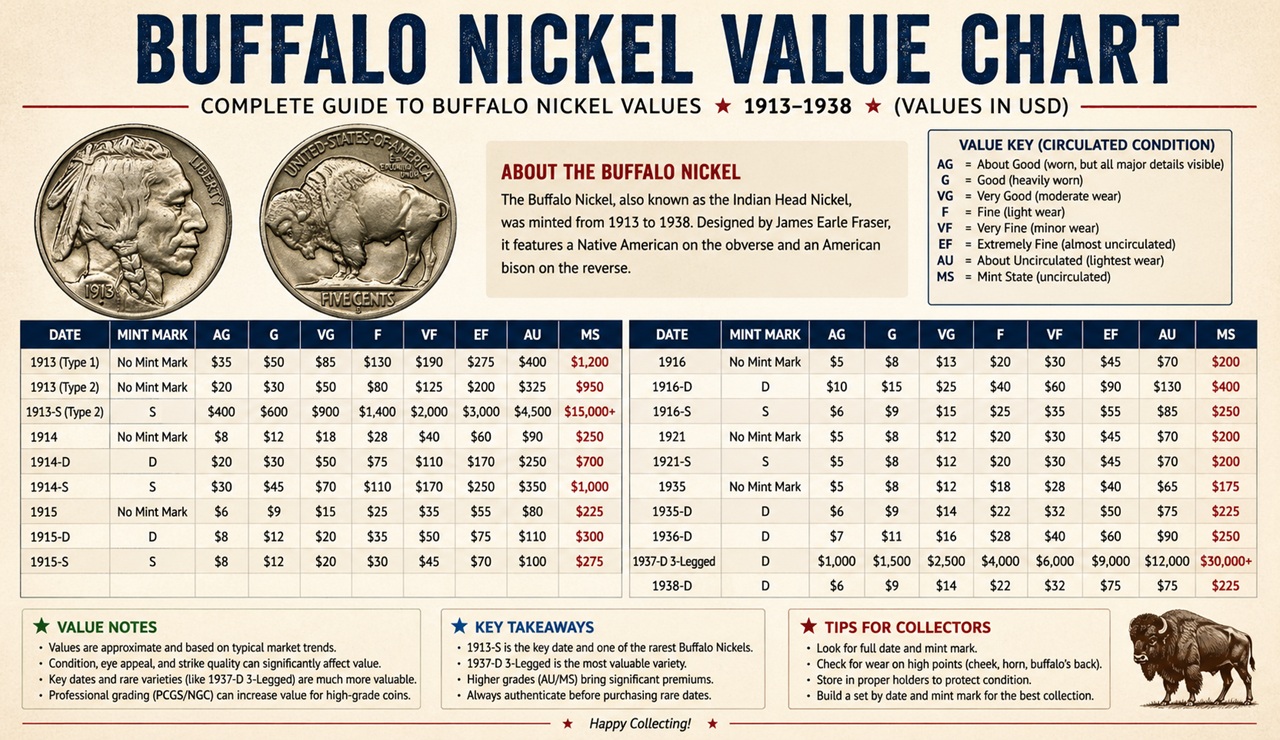
This Buffalo nickel value chart breaks down prices by year, mint mark, and grade — so you know exactly what you’re holding before you sell, trade, or keep it forever.
Table of Contents
- What Is a Buffalo Nickel?
- Buffalo Nickel Value Chart by Year and Mint Mark
- How Grade Affects Value
- Most Valuable Buffalo Nickels
- Quick Insights: What Makes a Buffalo Nickel Rare?
- Key Takeaways
- FAQs
What Is a Buffalo Nickel?
The Buffalo nickel — officially called the Indian Head nickel — was minted from 1913 to 1938. Designed by James Earle Fraser, it features a Native American profile on the obverse and an American bison on the reverse.
These coins were struck at three mints: Philadelphia (no mint mark), Denver (D), and San Francisco (S). The mint mark appears on the reverse, below “FIVE CENTS.”
Because they circulated heavily, most Buffalo nickels show significant wear. However, well-preserved examples are highly sought after by collectors and command serious premiums.
Buffalo Nickel Value Chart by Year and Mint Mark
Below is a simplified Buffalo nickel price guide covering key dates and conditions. Values are approximate based on current market trends.
| Year & Mint | Good (G-4) | Fine (F-12) | XF (EF-40) | MS-63 |
|---|---|---|---|---|
| 1913 (Type 1) | $15 | $30 | $65 | $175 |
| 1913-D (Type 1) | $20 | $45 | $100 | $250 |
| 1913-S (Type 1) | $30 | $65 | $150 | $500 |
| 1916 | $8 | $18 | $45 | $175 |
| 1918/7-D | $500 | $1,500 | $6,000 | $30,000+ |
| 1921-S | $35 | $100 | $400 | $2,500 |
| 1926-S | $20 | $65 | $350 | $4,000 |
| 1937-D (3-Leg) | $500 | $750 | $1,200 | $4,500 |
| 1938-D | $6 | $9 | $12 | $45 |
Note: Prices fluctuate based on market demand, coin show trends, and auction results. Always verify with a current PCGS or NGC price guide.
How Grade Affects Buffalo Nickel Value
Grading is everything when it comes to Buffalo nickel worth. A coin graded MS-65 (gem uncirculated) can be worth 10x or even 100x more than the same date in Good condition.
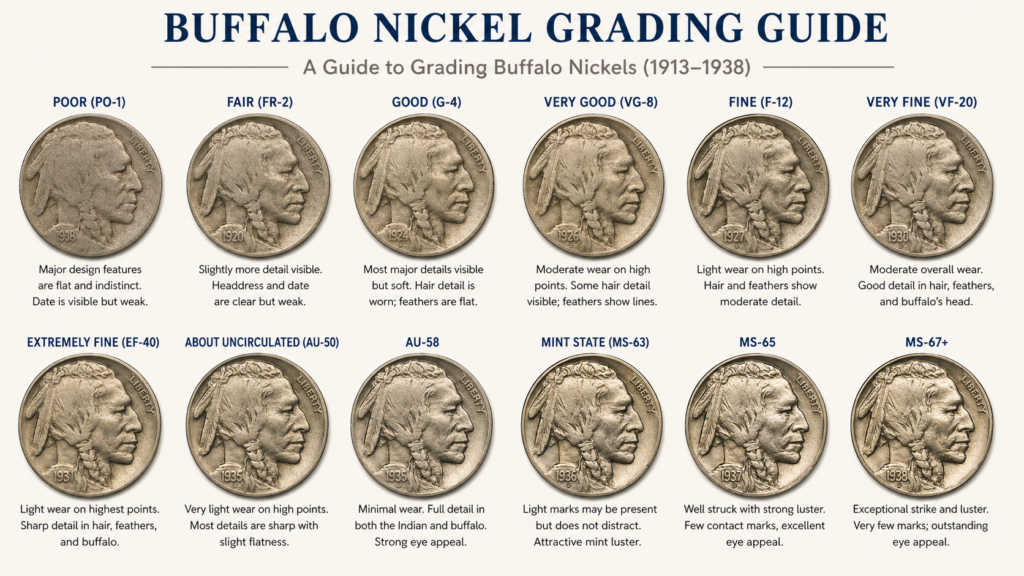
Here’s a quick grading overview:
- Poor / Fair (P-1 to F-2): Heavy wear. Date may be faint or missing entirely.
- Good (G-4 to G-6): Outline visible, but details are flat. Common grades for circulated examples.
- Fine (F-12 to F-15): Moderate wear. Some detail on the bison’s horn and hair.
- Extremely Fine (EF-40): Light wear on high points only. Strong detail overall.
- Mint State (MS-60 to MS-70): No wear. Original luster present. These are the coins collectors fight over.
The date and mint mark are the first things to check. On heavily worn Buffalo nickels, the date sometimes disappears completely — this is called a “dateless Buffalo nickel,” and those are generally worth only $1–$3 for novelty purposes.
Most Valuable Buffalo Nickels
Some dates in this series are genuinely rare. Here are the top coins serious collectors target:
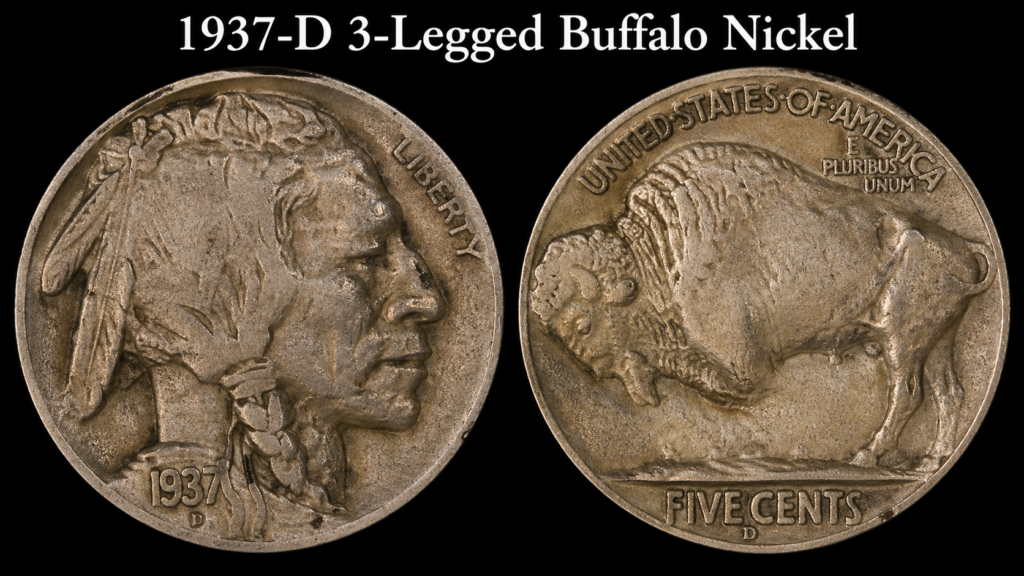
- 1918/7-D Overdate — One of the most dramatic errors in the series. Worth $500+ even in lower grades.
- 1937-D 3-Legged Buffalo — A famous die polishing error removed one of the bison’s legs. Worth $500–$5,000+ depending on grade.
- 1916 Doubled Die Obverse — Subtle but valuable. Worth $300–$3,000 in nicer grades.
- 1926-S — Low mintage makes this date scarce. Even circulated examples are worth $20–$350.
- 1913-S Type 2 — The first-year S-mint coin in the flat-ground reverse design. Always in demand.
These rare Indian Head nickel varieties reward careful examination. A good loupe or magnifier is essential.
Quick Insights: What Makes a Buffalo Nickel Rare?
Three factors drive rarity and value in this series:
- Low mintage: Fewer coins struck = harder to find today.
- Die errors: Overdates, doubled dies, and polishing errors create collector favorites.
- Survival rate: Coins that avoided heavy circulation are exponentially rarer.
Also worth noting — full horn designation matters. On Buffalo nickels, the bison’s horn must be fully struck and visible for top-grade premiums. A coin labeled “Full Horn” by PCGS or NGC commands a significant bonus.
Just like the 1943 steel penny — where condition and mint errors dramatically shift value — your Buffalo nickel’s worth depends heavily on what the coin experienced over the past century.
Key Takeaways
- The Buffalo nickel value chart ranges from under $1 (dateless) to $30,000+ (rare errors in mint state).
- Mint marks (D and S) generally add value compared to Philadelphia issues.
- Grade is the single biggest factor in determining price.
- Key dates: 1918/7-D, 1937-D 3-Legged, 1916 DDO, 1926-S.
- Always use PCGS or NGC for professional grading on valuable coins.
Conclusion
The Buffalo nickel value chart tells a fascinating story — one where a common five-cent coin can quietly become a $5,000 treasure based on a single digit, mint mark, or die error. Whether you’re a casual collector or actively building a set, knowing the price guide by year and grade is your foundation.
Check your dates. Look for mint marks. And when in doubt, send key coins to PCGS or NGC for professional grading. That one step can mean the difference between selling for $10 — and selling for $1,000.
Ready to dig deeper? Browse our full rare coin guides and start identifying what else might be hiding in your collection.
FAQs
Q1: What is a Buffalo nickel worth today? Most circulated Buffalo nickels are worth $1–$10 depending on date and condition. However, key dates and error coins in higher grades can be worth hundreds or thousands of dollars.
Q2: How do I read the mint mark on a Buffalo nickel? Flip the coin to the reverse side. Look just below “FIVE CENTS” on the bottom center. You’ll see a “D” for Denver, “S” for San Francisco, or nothing for Philadelphia.
Q3: What does a dateless Buffalo nickel mean? When the date wears off completely from heavy circulation, the coin is called “dateless.” These are worth roughly $1–$3 and are sometimes novelty items or used in jewelry.
Q4: Which Buffalo nickel is the rarest? The 1937-D 3-Legged Buffalo and the 1918/7-D overdate are among the most prized. The 3-legged variety results from over-polishing a die, making it a popular and visually striking error.
Q5: Should I clean my Buffalo nickel before selling? No — never clean old coins. Cleaning removes original patina and luster, drastically reducing collector value. A cleaned coin can lose 50–80% of its market value compared to an original-surface example.