
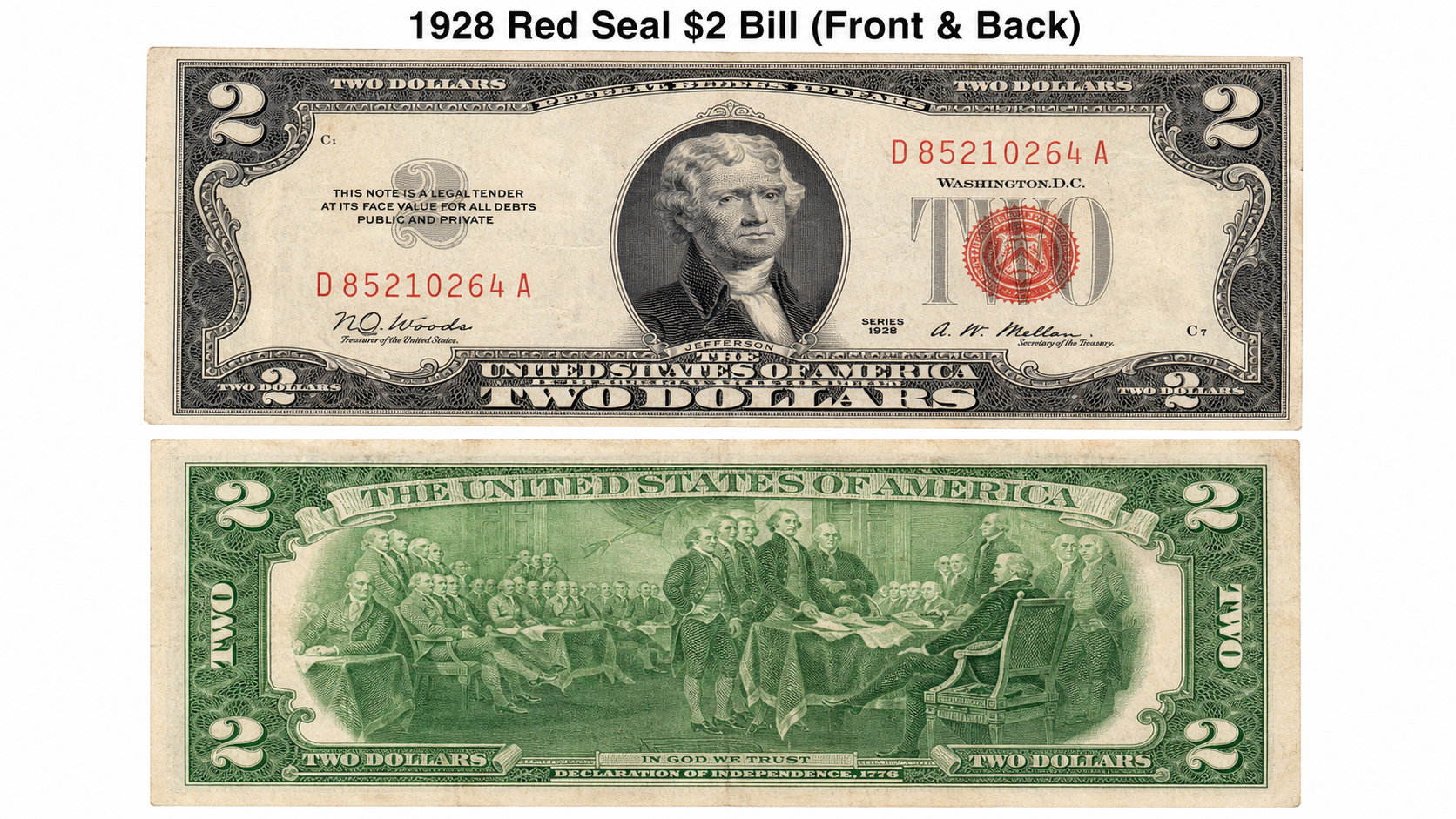
Have you ever stumbled across an old $2 bill and wondered if it might be worth more than face value? If that bill has a bold red seal, you might be holding a genuine piece of American monetary history. According to the Bureau of Engraving and Printing official currency history, 1928 marked a landmark redesign of all U.S. paper money — including the first small-size $2 bill.
Whether you’re a seasoned numismatist or just getting started, understanding what sets this note apart can help you make smarter decisions about buying, selling, or simply appreciating what you have.
Table of Contents
- What Is the 1928 Red Seal $2 Bill?
- History Behind the Red Seal
- What Makes It So Collectible?
- How Much Is a 1928 $2 Bill Worth Today?
- Key Varieties and Serial Numbers to Know
- How to Identify a Genuine 1928 Red Seal Note
- Tips for Collectors
- FAQs
- Conclusion
What Is the 1928 Red Seal $2 Bill?
The 1928 Red Seal $2 bill is a United States Legal Tender Note — not a Federal Reserve Note. That distinction matters more than most people realize. Legal Tender Notes were backed directly by the U.S. government, not a Federal Reserve Bank, which is why they carry that eye-catching red Treasury seal on the right side.
First issued in 1928, this was actually the first small-size $2 bill ever printed. Before 1928, U.S. currency came in a much larger format. The switch to the smaller size made these early notes a landmark in American currency design.
History Behind the Red Seal
The red seal on the 1928 $2 bill isn’t just decorative. It signals that the note is a United States Note, a classification that dates back to the Civil War era. These notes were issued directly by the Treasury Department and carried full legal tender status.
The 1928 series ran through several sub-series: 1928, 1928A, 1928B, 1928C, 1928D, 1928E, and 1928F. Each sub-series was released under a different Secretary of the Treasury or Treasurer signature combination, making them individually trackable — and collectible.
For a deeper look at how the $2 bill evolved over more than a century, see the full United States two-dollar bill history on Wikipedia.
What Makes It So Collectible?
Several factors combine to make the 1928 Red Seal $2 bill a collector favorite:
- Historical significance — It’s the first small-size $2 Legal Tender Note ever issued.
- Distinctive appearance — The red seal and red serial numbers make it visually striking.
- Age — At nearly 100 years old, surviving examples in good condition are genuinely scarce.
- Variety depth — Multiple sub-series give collectors a clear set to chase and complete.
- Low survival rate in high grades — Most circulated examples show significant wear, making crisp uncirculated notes rare.
Many collectors specifically target star notes — replacement notes printed when a standard note was damaged during production. These carry a star symbol (★) at the end of the serial number and command a meaningful premium.
How Much Is a 1928 $2 Bill Worth Today?
The value of a 1928 $2 bill depends heavily on condition, sub-series, and whether it’s a star note.
| Condition | Approximate Value |
|---|---|
| Well Circulated (Good–Fine) | $8 – $25 |
| Extremely Fine | $30 – $75 |
| Uncirculated (MS 63+) | $100 – $300+ |
| Star Note (Circulated) | $50 – $150 |
| Star Note (Uncirculated) | $300 – $1,000+ |
Rarer sub-series like the 1928E are significantly more valuable due to lower print runs. A 1928E in uncirculated condition can fetch well over $1,500 at auction.
For certified notes graded by PCGS Currency or PMG (Paper Money Guaranty), values can climb even higher — particularly for notes graded 65 EPQ (Gem Uncirculated) or above.
Key Varieties and Serial Numbers to Know
Not all 1928 Red Seal $2 bills are equal. Here’s what to watch for:
- 1928 (Base Series) — Most common; still collectible in high grades.
- 1928A through 1928D — Moderate scarcity; solid collector demand.
- 1928E — Low print run; significantly scarcer than earlier series.
- 1928F — Transitional; interesting to specialists.
- Star Notes (any sub-series) — Always command a premium. Even a circulated star note from 1928 is worth researching further.
Low serial numbers (under 100) and solid serial numbers (e.g., 22222222) also attract collector premiums regardless of grade.
How to Identify a Genuine 1928 Red Seal Note
Spotting an authentic 1928 Red Seal $2 bill isn’t difficult once you know what to look for:
- Red Treasury seal on the right side of the bill’s face.
- Red serial numbers — both the prefix and suffix letters will appear in red.
- “United States Note” printed clearly at the top.
- Portrait of Thomas Jefferson centered on the front.
- Monticello depicted on the reverse.
- Series date printed near the portrait — look for 1928, 1928A, 1928B, etc.
If the seal or serial numbers appear orange or faded, the bill may have been cleaned or exposed to harsh conditions, which reduces value significantly.
Tips for Collectors
Whether you’re just starting out or adding to an established collection, keep these points in mind:
- Never clean your bills. Cleaning destroys originality and dramatically reduces value.
- Store notes flat in archival-quality currency sleeves or holders.
- Consider professional grading for high-grade examples — a PMG or PCGS holder adds credibility and market value.
- Research auction records on Heritage Auctions or Stack’s Bowers before buying or selling.
- Focus on condition — a single upgrade in grade can double or triple the value.
If you enjoy hunting for rare currency, you might also appreciate coin roll hunting strategies to find rare coins at the bank — the same patience and attention to detail applies.
Quick Insight: Why This Note Still Matters
The 1928 Red Seal $2 bill sits at the intersection of American history and numismatic collecting. It represents a moment when the U.S. government was redesigning its entire currency system. Holding one is holding a tangible piece of that transition — and that story doesn’t lose its appeal.
Key Takeaways
- The 1928 Red Seal $2 bill is a United States Legal Tender Note, not a Federal Reserve Note.
- It was the first small-size $2 bill ever issued.
- Values range from $8 for worn examples to over $1,000+ for uncirculated star notes.
- Sub-series like 1928E are significantly scarcer and more valuable.
- Condition and certification are the two biggest drivers of market value.
The 1928 Red Seal $2 bill isn’t just old paper — it’s a documented piece of American financial history that continues to captivate collectors nearly a century later. From its striking red seal to its status as the first small-size Legal Tender $2 note, there’s a lot packed into this compact bill.
If you think you have one, take time to assess its condition carefully, check the sub-series, and look for that star symbol. You might be sitting on something genuinely special.
Ready to learn more about rare currency and coins? Explore our guides on how to grade coins at home and discover more about the 1931-S Lincoln Wheat Penny — another classic rarity worth knowing.
FAQs
Q1: What makes the 1928 Red Seal $2 bill different from modern $2 bills? Modern $2 bills are Federal Reserve Notes with a green seal. The 1928 version is a United States Legal Tender Note with a distinctive red seal and red serial numbers, backed directly by the Treasury.
Q2: Are all 1928 Red Seal $2 bills valuable? Most are worth more than face value, but condition matters greatly. Heavily circulated notes in poor condition may only bring $8–$15. High-grade or star note examples can be worth hundreds or more.
Q3: How do I know if my 1928 $2 bill is a star note? Look for a small star (★) at the end of the serial number. Star notes are replacement notes and typically carry a meaningful collector premium over standard examples.
Q4: Should I get my 1928 $2 bill professionally graded? If the note appears uncirculated or is a star note, professional grading by PMG or PCGS Currency is strongly recommended. It protects the note, confirms authenticity, and generally increases resale value.
Q5: Where can I sell a 1928 Red Seal $2 bill? Reputable options include Heritage Auctions, eBay (for lower-grade examples), Stack’s Bowers, or local currency shows. For high-value notes, auction houses typically achieve the best prices.