
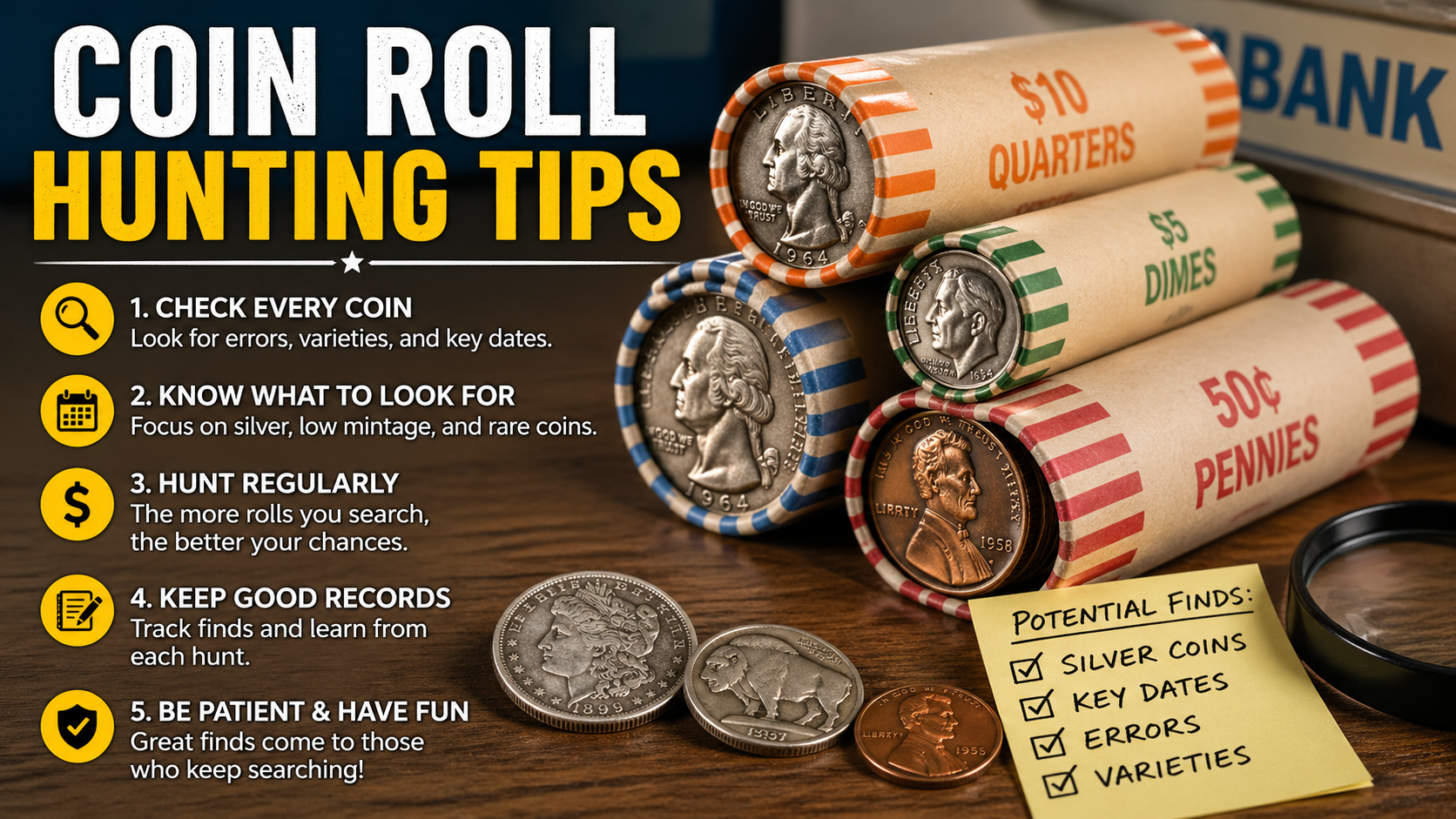
What if your next trip to the bank could make you hundreds — or even thousands — of dollars richer?
Coin roll hunting is one of the most exciting and budget-friendly hobbies in the world of numismatics. Every roll of pennies, nickels, dimes, or half dollars could be hiding a rare coin that most people never notice. The best part? You search at face value and only pay for what you keep.
Whether you’re a curious beginner or a seasoned collector, these coin roll hunting tips will show you exactly how to find rare and valuable coins hiding in plain sight inside ordinary bank rolls.
What Is Coin Roll Hunting?
Coin roll hunting (CRH) is the practice of purchasing rolls of coins from a bank, searching through them for rare, old, or valuable pieces, and then returning the ones you don’t want — all at face value.
It costs nothing extra. A $25 box of half dollars is still worth $25 when you return it. But if you find a 1964 Kennedy half dollar or a 90% silver Roosevelt dime inside, you’ve just scored big with zero risk.
Why Coin Roll Hunting Is Worth Your Time
Before diving into the tips, here’s the quick case for why this hobby matters:
- Silver coins from before 1965 are worth multiple times their face value in melt value alone.
- Error coins — like doubled dies or off-center strikes — regularly sell for $50 to $500+.
- Key date coins (like 1955 pennies or 1942/41 Mercury dimes) can appear in any roll.
- It’s risk-free: you return the non-keepers and get your money back.
Even a single silver dime found in a $5 roll of dimes pays for itself many times over.
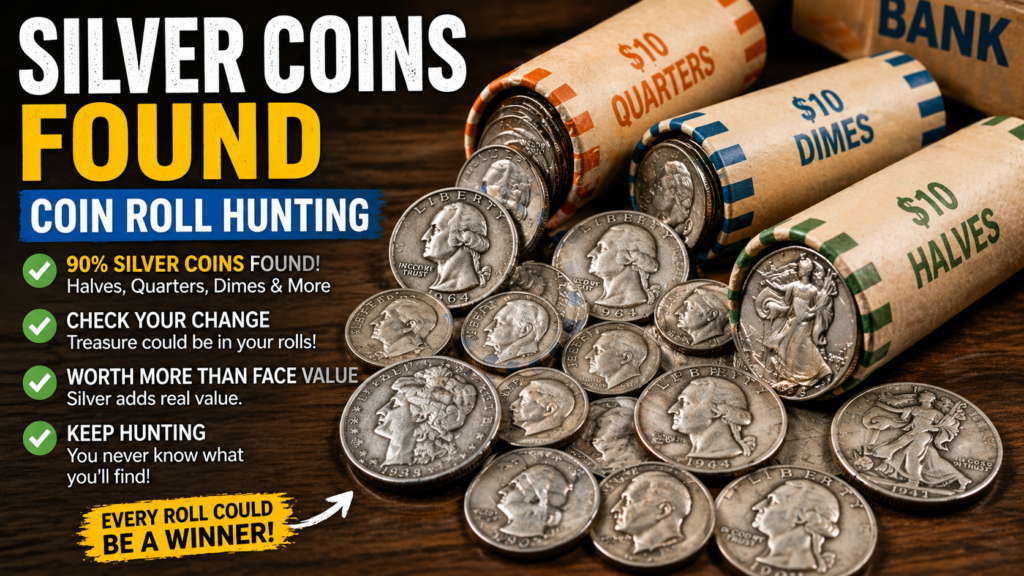
Top Coin Roll Hunting Tips for Finding Rare Coins
1. Know Which Coin Rolls to Request
Not all rolls are created equal. Some denominations yield better finds than others.
- Half dollars are the top choice for CRH. Many banks still carry 40% or 90% silver halves from the 1960s.
- Nickels are excellent for finding Buffalo nickels and pre-1960 Jefferson nickels.
- Pennies can reveal wheat cents, Indian Head cents, and valuable Lincoln errors.
- Dimes may contain Roosevelt or Mercury dimes made of 90% silver (pre-1965).
Pro Tip: Ask your bank teller for customer-wrapped rolls rather than machine-wrapped ones. Customer rolls are more likely to contain older coins.
2. Build Relationships with Bank Tellers
This is one of the most underrated coin roll hunting tips. If you regularly visit the same branch, tellers will start saving boxes of half dollars or loose coin bags just for you.
Be polite, tip occasionally with a coffee, and let them know what you’re looking for. Many hunters have standing arrangements with local banks that give them first access to interesting rolls.
3. What to Look For in Each Roll
When sorting through coins, train your eye to spot:
For Silver:
- Dimes and quarters dated 1964 and earlier (90% silver)
- Half dollars dated 1965–1970 (40% silver)
- Look for the lack of copper edge — silver coins have a solid silver edge, not the copper sandwich visible in modern coins.
For Errors:
- Doubled die coins — look for doubling in the lettering or date
- Off-center strikes — the design is misaligned from the coin’s center
- Clipped planchets — coins with missing edges where the blank was cut improperly
- Wrong planchet errors — a dime struck on a penny blank, for example
For Key Dates:
- 1955 doubled die penny
- 1916-D Mercury dime
- 1942/41 overdate dime
- 1950-D Jefferson nickel
4. Use the Right Tools
You don’t need fancy equipment, but a few tools make a real difference:
- Magnifying loupe (5x–10x) — for spotting doubled dies and mint marks
- Good lighting — a bright desk lamp reveals details that overhead light misses
- Coin sorting tray — speeds up the sorting process significantly
- Reference book or app — like the Red Book (A Guide Book of United States Coins) or the PCGS CoinFacts app
5. Organize a Scalable System
Successful hunters don’t just dump coins out randomly. They follow a system:
- Open the roll carefully — avoid scratching coins with sharp tools
- Sort by date range first — pull anything pre-1965 immediately
- Check edges for silver coins before inspecting the face
- Inspect face and reverse under magnification for errors
- Store keepers in coin tubes or flips with date labels
- Return rejects to the bank in rolled form
A system saves time and ensures you don’t miss anything.
6. Track Your Finds and Profits
Keep a simple log of every box you search. Note what you found, estimated value, and where the roll came from. Over time, patterns emerge — certain banks or certain roll types yield better results.
Many hunters report finding silver coins at a rate of 1–3 per $100 searched. That’s a consistent profit margin without any investment risk.
7. Don’t Sleep on Half Dollar Boxes
The $500 half dollar box is the crown jewel of coin roll hunting. Half dollars circulate far less than pennies or dimes, meaning older coins stay in circulation longer.
Many hunters find 90% silver Kennedy halves (dated 1964) in half dollar boxes with surprising regularity. A single 1964 Kennedy half dollar in circulated condition is worth $7–$10+ in silver melt value alone — and sometimes much more to collectors.
8. Learn to Spot Error Coins Fast
Error coins are among the most profitable finds in any roll. They’re the result of minting mistakes, and no two are identical.
The most valuable errors include doubled dies, repunched mint marks, and off-metal strikes. Before you start hunting, study what common errors look like so you can recognize them in seconds.
Quick Insights: What Makes a Coin Valuable?
| Factor | Why It Matters |
|---|---|
| Age | Older coins are rarer in circulation |
| Mint Mark | Some mints produced far fewer coins |
| Condition | Even worn silver is worth melt value |
| Error Type | Errors dramatically increase collector value |
| Silver Content | Pre-1965 coins have real precious metal value |
Key Takeaways
- Coin roll hunting is free to start and completely risk-free
- Half dollar boxes offer the best odds for silver finds
- Pre-1965 coins contain silver and are worth well above face value
- Error coins can fetch $50–$500+ depending on type and rarity
- Build bank relationships to get consistent access to rolls
- Use a loupe and good lighting to spot doubled dies and errors
- Track your finds to identify trends and maximize your searches
Conclusion
Coin roll hunting is one of the few hobbies where patience truly pays — sometimes literally. Every roll you open is a small lottery ticket with real odds of finding something genuinely valuable.
By following these coin roll hunting tips, you’ll search smarter, spot silver and errors faster, and build a collection that grows in value over time.
Ready to start? Visit your bank this week, grab a box of half dollars, and put these strategies to work. Your next great find could already be sitting in a roll — waiting for you.
Frequently Asked Questions
Q1: Is coin roll hunting worth it? Yes — especially for silver coins and errors. A single silver dime is worth 15–20x face value. You return all non-keepers at face value, so there’s no financial risk.
Q2: Which coins should I hunt first as a beginner? Start with half dollar boxes. They have the highest likelihood of containing silver halves from the 1960s. Penny rolls are a good low-cost entry point for finding wheat cents.
Q3: How do I know if a coin is silver? Check the edge. Silver coins show no copper layer — the edge appears uniformly silver. Also check the date: dimes and quarters before 1965 and halves before 1971 may be silver.
Q4: Where do I get coin rolls for hunting? Ask at any bank branch. You can request rolls of any denomination. Some hunters visit multiple banks weekly. Credit unions and smaller community banks often have older coins.
Q5: Can I find a Buffalo nickel in a bank roll today? It’s rare but not impossible. Buffalo nickels occasionally appear in nickel rolls. Knowing their value helps — some dates are worth $20–$200+.