
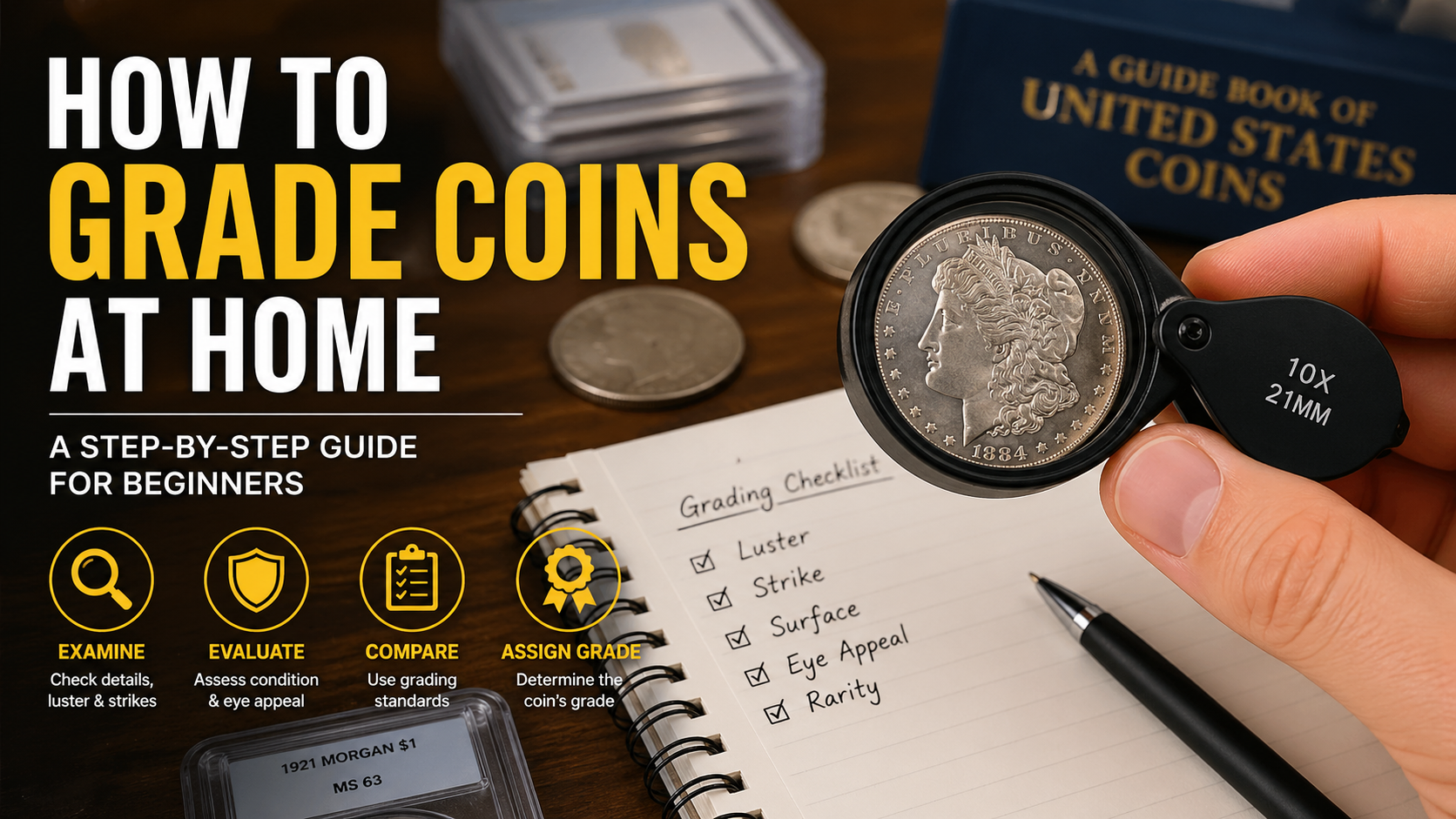
Imagine holding a coin that looks ordinary — only to discover it’s worth hundreds of dollars. That’s the power of coin grading. And here’s the exciting part: you don’t need to be a professional numismatist to do it.
Learning how to grade your own coins at home is one of the most valuable skills a collector can develop. It saves you money on professional grading fees, helps you identify genuinely rare pieces before selling, and deepens your appreciation for the hobby.
In this step-by-step beginner’s guide, you’ll learn everything you need to start grading coins confidently — right from your kitchen table.
What Is Coin Grading? (Quick Answer)
Coin grading is the process of evaluating a coin’s condition and assigning it a numeric grade on the Sheldon Scale (1–70). The grade reflects the level of wear, luster, and surface quality. Higher grades mean better condition — and significantly higher value. For example, a coin graded MS-65 can be worth 10x more than the same coin at VF-20.
Table of Contents
- 1. Tools You Need to Grade Coins at Home
- 2. Understanding the Sheldon Coin Grading Scale
- 3. How to Grade Your Own Coins at Home: Step-by-Step
- 4. Common Coin Grading Mistakes Beginners Make
- 5. When to Consider Professional Coin Grading
- 6. Key Takeaways
- 7. FAQs
- 8. Conclusion
1. Tools You Need to Grade Coins at Home
Before you start, gather the right tools. You won’t need expensive equipment — just a few essentials.
- 10x to 16x jeweler’s loupe or magnifying glass
- Bright, direct light source (LED lamp or natural daylight)
- Cotton or latex gloves to avoid fingerprints
- A soft velvet or felt coin tray
- A printed or digital copy of the Sheldon Scale
- Reference book such as the PCGS Coin Grading & Counterfeit Detection Guide
Good lighting is the single most important factor. Tilt the coin at different angles under direct light. This reveals hairlines, luster, and contact marks that flat overhead lighting will completely hide.
2. Understanding the Sheldon Coin Grading Scale
The Sheldon Scale runs from 1 (Poor) to 70 (Perfect Uncirculated). Here are the major grade categories every beginner should know:
- Poor (P-1): Barely identifiable. Date and design almost gone.
- Fair (F-2): Heavily worn. Major details visible.
- Good (G-4 to G-6): Heavily worn but design clear. No fine details.
- Very Good (VG-8 to VG-10): Well worn. Main features clear and bold.
- Fine (F-12 to F-15): Moderate even wear on high points.
- Very Fine (VF-20 to VF-35): Light to moderate wear. Most details sharp.
- Extremely Fine (EF-40 to EF-45): Light wear on high points only.
- About Uncirculated (AU-50 to AU-58): Slight wear on highest points. Good luster.
- Mint State (MS-60 to MS-70): No wear at all. Ranges from heavily marked to perfect.
Pro Tip: When coin grading for beginners, focus first on circulated grades (Good through AU). Mint State grading is more nuanced and requires more experience.
3. How to Grade Your Own Coins at Home: Step-by-Step
Step 1: Handle the Coin Properly
Always hold coins by their edges. Never touch the faces. Even clean hands leave oils that damage coin surfaces over time. Use gloves whenever possible.
Step 2: Examine the Coin Under Light
Hold the coin under a direct light source. Tilt it slowly at different angles — roughly 45 degrees is ideal. Watch how the light moves across the surface. This technique, called “roll testing,” reveals wear patterns that aren’t visible in flat light.
Step 3: Assess the High Points First
High points are the parts of the design that stick out most — like the cheekbone on a Liberty head or the eagle’s breast feathers. These areas wear first. If the high points are sharp, your coin is likely in higher grade territory.
Step 4: Check for Luster
Luster is the cartwheel-like sheen that radiates from uncirculated coins. It’s caused by the microscopic flow lines created during minting. Any wear destroys luster instantly. If you see luster on 50% or more of the surface, you may have an About Uncirculated (AU) coin.
Step 5: Look for Contact Marks and Hairlines
Use your loupe here. Contact marks are small nicks from coins bumping against each other in bags. Hairlines are fine scratches from cleaning. Both lower a coin’s grade significantly — especially on Mint State coins.
Step 6: Assign a Preliminary Grade
Based on your observations, assign a grade range. Start broad — is this coin circulated or uncirculated? Then narrow it down. Compare your coin to PCGS or NGC photo grading guides online.
Step 7: Check Both Sides
Always grade both the obverse (heads) and reverse (tails). The final grade is usually determined by the weaker side. Therefore, a coin with a VF-35 obverse and VF-25 reverse is typically graded VF-25 overall.
4. Common Coin Grading Mistakes Beginners Make
- Cleaning coins: Never clean a coin. Even gentle polishing destroys luster and drops the grade — and the value.
- Grading under poor lighting: Insufficient light masks wear and surface problems.
- Confusing die polish with hairlines: Die polish lines are raised and run in one direction. Hairlines are incuse (cut in) and random.
- Over-grading sentimental coins: It’s human nature. However, the market doesn’t pay for sentiment.
- Ignoring the reverse: Many beginners focus only on the obverse and miss wear on the reverse.
5. When to Consider Professional Coin Grading
DIY coin grading is great for building knowledge — but it has limits. Consider sending coins to PCGS or NGC when:
- Your coin appears to grade MS-65 or higher
- You believe you have a rare date or mint mark variety
- You plan to sell the coin for $100 or more
- You need authentication (checking for counterfeits or alterations)
Professional grading costs $20–$150 per coin depending on the service tier. For high-value coins, the cost is absolutely worth the credibility it adds at auction.
Dig Deeper: Related Guides
Want to find coins worth grading? Read our guide on coin roll hunting tips to find rare coins at the bank. You should also check out the most valuable error coins found in circulation — because grading error coins requires special knowledge. If you collect classic American coins, our Buffalo Nickel value chart and price guide will show you exactly what grades command the highest premiums.
Key Takeaways
- The Sheldon Coin Scale (1–70) is the universal standard for numismatic grading at home.
- Good lighting and a quality loupe are your two most essential tools.
- Always examine high points, luster, contact marks, and hairlines.
- Grade both sides of the coin — the final grade reflects the weaker side.
- Never clean a coin. It destroys value and grade instantly.
- Use PCGS or NGC photo guides to compare and calibrate your eye.
- Send high-value coins (likely MS-65+) to professional graders before selling.
Conclusion
Knowing how to grade your own coins at home is a game-changer for any collector. It saves money, sharpens your eye, and helps you make smarter decisions — whether you’re buying, selling, or simply building a collection you love.
Start with the basics: gather your tools, study the Sheldon Scale, and practice on a handful of circulated coins. With every coin you examine, your grading eye will improve.
Ready to put your new skills to work? Start by going through your current collection today — you might be sitting on something far more valuable than you realize.
Frequently Asked Questions
Q1: Can I really grade coins accurately at home without training?
Yes — with practice. Beginners can reliably grade circulated coins within one or two grade points using a loupe and reference guides. Mint State grading takes more time to learn, but circulated coin grading for beginners is very achievable.
Q2: What magnification is best for coin grading?
A 10x loupe is the industry standard used by professional numismatists. Some collectors prefer 16x for spotting fine hairlines. Avoid going higher than 20x — at that magnification, even high-grade coins look heavily damaged.
Q3: Does cleaning a coin improve its grade?
Never. Cleaning always lowers a coin’s grade. Even mild cleaning destroys the original luster and leaves microscopic scratches (hairlines). A cleaned coin is typically marked “details” by grading services, which significantly reduces its market value.
Q4: What’s the difference between MS-60 and MS-65?
Both are uncirculated, but MS-65 has far fewer contact marks and better eye appeal. In terms of value, the difference can be enormous. A 1921 Morgan Dollar at MS-60 might sell for $50, while the same coin at MS-65 can fetch $500 or more.
Q5: How do I know if my coin is worth sending to PCGS or NGC?
A simple rule: if your DIY coin grading suggests the coin is MS-64 or higher, or if it’s a key date variety, the cost of professional grading is almost always justified. Check the PCGS Price Guide to estimate value before submitting.
1 thought on “How to grade your own coins at home: a step-by-step beginner’s guide”