
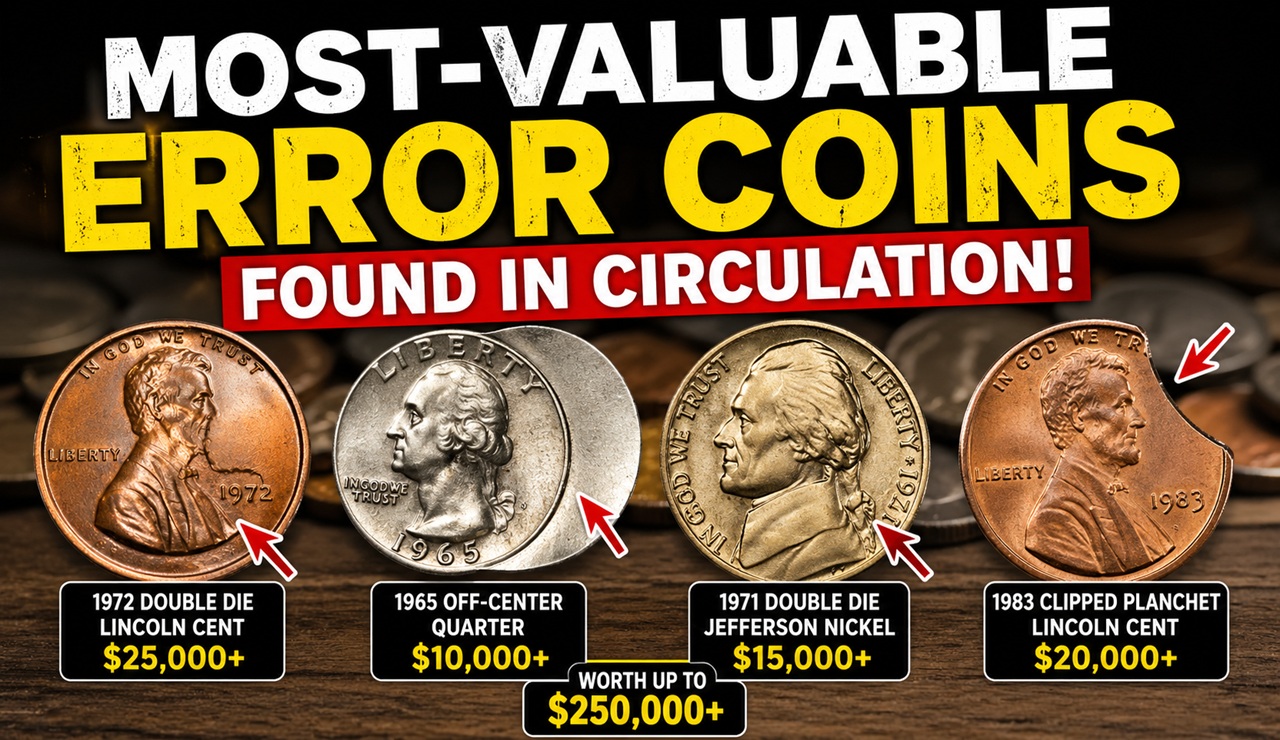
What if a coin in your pocket was worth $10,000?
It sounds impossible. But every year, ordinary people find extraordinarily rare error coins in everyday change — coins that mints accidentally released with major mistakes. Some have sold for hundreds of thousands of dollars at auction.
The most valuable error coins found in circulation aren’t locked in museums. They’re hiding in jars of loose change, cash registers, and old wallets. This guide shows you exactly what to look for — and how to identify them before they slip through your fingers.
Table of Contents
- What Are Error Coins?
- The Most Valuable Error Coins Ever Found in Circulation
- How to Spot Error Coins Like a Pro
- Quick Insights: What Makes Error Coins So Valuable?
- Key Takeaways
- FAQs
What Are Error Coins?
Error coins are coins that were produced incorrectly at the U.S. Mint — and then accidentally released into circulation. These mistakes happen during the striking, planchet preparation, or die manufacturing process.
There are four main error types:
- Doubled Die – The design appears doubled or overlapping
- Off-Center Strike – The design is shifted away from center
- Wrong Planchet – A coin is struck on the wrong metal blank
- Die Cap / Brockage – A coin sticks to the die and creates mirror impressions
Because most mint errors are caught before release, the ones that escape are extremely rare — and therefore extremely valuable.
The Most Valuable Error Coins Found in Circulation
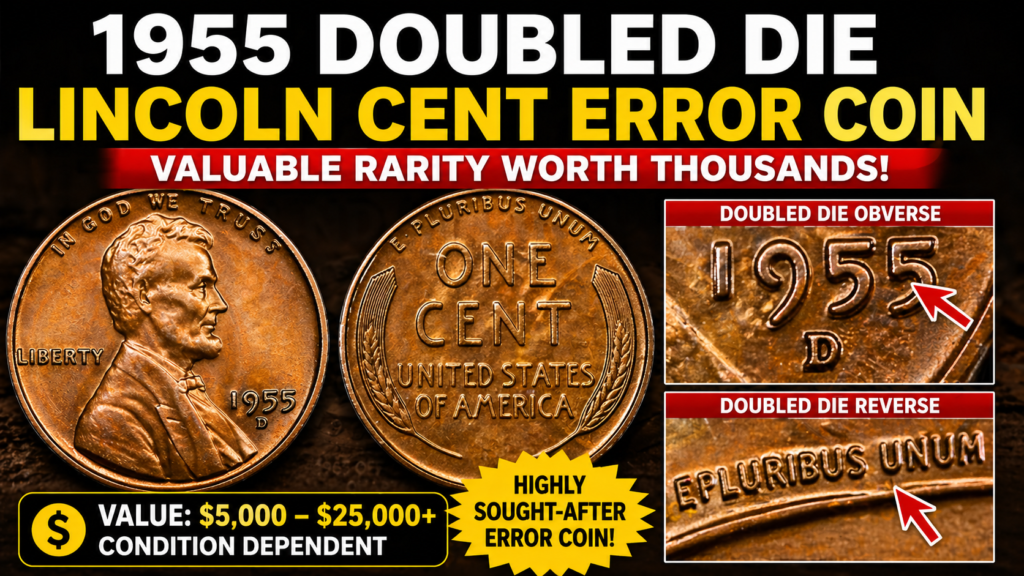
1. 1955 Doubled Die Lincoln Cent
This is arguably the most famous error coin ever released. The date and lettering on the obverse appear dramatically doubled, making it easy to spot even without magnification.
Found in cigarette vending machines in 1955, around 20,000 examples escaped. However, most are now in collector hands. Fine-grade examples regularly sell for $1,500–$2,000. High-grade specimens have exceeded $50,000 at auction.
What to look for: Check the date “1955” and the words “LIBERTY” and “IN GOD WE TRUST” for obvious doubling.
2. 2004 Wisconsin State Quarter — Extra Leaf Variety
This is one of the most talked-about modern error coins worth money. Found in Arizona circulation in 2004, some Wisconsin state quarters show an extra leaf on the ear of corn — either pointing high or low.
These weren’t officially produced that way. Thousands entered circulation before anyone noticed. Today, they sell for $100–$500 depending on condition — and you can still find them in change.
3. 1943 Copper Lincoln Cent
During World War II, pennies were made from steel to conserve copper. But a handful of copper planchets accidentally made it through the press. Fewer than 30 authentic examples are known.
One sold for $204,000 at auction. Even circulated specimens are worth $60,000+. This is the holy grail of valuable coins in circulation.
Quick test: A 1943 penny that sticks to a magnet is steel (common). One that doesn’t? Get it authenticated immediately.
4. 1969-S Doubled Die Lincoln Cent
Even more dramatic than the 1955 error, the 1969-S doubled die shows extreme doubling across the entire obverse. So dramatic, in fact, that the Secret Service initially thought circulating examples were counterfeit.
Only a few dozen are confirmed. An MS-64 Red example sold for over $126,500. Finding one in circulation today would be extraordinarily rare — but not impossible.
5. 1937-D Three-Legged Buffalo Nickel
This beloved rarity occurred when a Mint worker over-polished a die, accidentally removing one of the buffalo’s front legs. The result is a buffalo that appears to float on three legs.
Circulated examples sell for $500–$2,000. Uncirculated specimens have crossed $10,000. They do still surface in old coin collections.
6. 2000-P Sacagawea Dollar / Washington Quarter Mule
A “mule” coin uses mismatched dies — in this case, the obverse of a Washington quarter struck with the reverse of a Sacagawea dollar. Only 19 are known to exist.
One sold for $155,250. This is the rarest modern error coin in U.S. history.
How to Spot Error Coins Like a Pro
Identifying rare mint error coins doesn’t require expensive equipment. Here’s a simple process:
- Use a 5x–10x loupe — Check all coins, especially pennies and quarters, under magnification
- Look at the date first — Doubled dies most commonly affect the date and lettering
- Check centering — Is the design noticeably off-center? That’s a significant error
- Examine the edge — Missing reeding, wrong thickness, or extra metal suggest planchet errors
- Test older pennies with a magnet — Non-magnetic 1943 pennies demand immediate professional review
- Compare to known examples — PCGS and NGC both have free online photo libraries
Quick Insights: What Makes Error Coins So Valuable?
Featured Snippet Answer: The most valuable error coins found in circulation are rare because mint errors are typically caught before release. When they escape, they combine extreme scarcity with documented history. Key factors include the number of known examples, the type and visibility of the error, coin grade, and provenance. Some are worth $100; others have exceeded $200,000.
Three factors drive value:
- Rarity — Fewer surviving examples = higher price
- Error visibility — A dramatic doubled die beats a subtle one
- Grade/Condition — Even error coins are graded; higher grades command premium prices
Key Takeaways
- Error coins are released accidentally by the U.S. Mint — and real ones are in circulation
- The 1943 copper penny, 1955 doubled die, and 1969-S doubled die are the most legendary finds
- Modern errors like the 2004 Wisconsin quarter can still be found in pocket change
- A basic loupe and knowledge of what to look for is all you need to start
- Always have potential finds authenticated by PCGS or NGC before buying or selling
Conclusion
Error coins are one of the most exciting corners of coin collecting — because the hunt is happening right now, in real time, in everyday change.
The most valuable error coins found in circulation weren’t discovered in archives or estate sales. They were spotted by people who knew what to look for. A little knowledge and a cheap loupe could turn a penny into a four-figure windfall.
Start checking your coins today. Look through that jar on your dresser. Examine the old rolls in your grandparents’ collection. You may already be holding something extraordinary.
FAQs
Q1: What is the most valuable error coin ever found in circulation? The 1943 Copper Lincoln Cent is widely considered the most valuable, with specimens selling for over $200,000. Fewer than 30 authentic examples are confirmed to exist worldwide.
Q2: Can I still find valuable error coins in everyday change? Yes. Modern errors like the 2004 Wisconsin Extra Leaf Quarter are still found in circulation. Checking your change regularly with a loupe significantly increases your chances.
Q3: How do I know if my error coin is real? Submit it to PCGS (Professional Coin Grading Service) or NGC (Numismatic Guaranty Corporation) for authentication. Both offer online submission services and are the gold standard for coin verification.
Q4: Are doubled die coins always valuable? Not always. Some doubled dies are minor and worth only a small premium. The most valuable are those with dramatic, easily visible doubling — especially on key design elements like the date or lettering.
Q5: What equipment do I need to find error coins? A 5x–10x jeweler’s loupe is sufficient for most errors. Good lighting is equally important. A magnet is useful for testing 1943 pennies. Professional grading photos from PCGS can help you compare your coin to known examples.