
Have you ever wondered if that loose change rattling in your pocket is actually worth more than face value? You might be holding something surprisingly valuable without even knowing it.
The euro coins value list with pictures is something every traveler, collector, and everyday spender should know. Whether you’re sorting coins after a Europe trip or starting a collection, understanding what each coin is worth can save — or even earn — you real money.
This complete guide breaks down every euro coin by value, design, and rarity. Let’s dive in.
Table of Contents
- What Are Euro Coins?
- Euro Coins Value List With Pictures
- Country-Specific Designs and Their Worth
- Rare Euro Coins Worth a Lot of Money
- How to Identify Valuable Euro Coins
- Key Takeaways
- FAQs
- Conclusion
What Are Euro Coins?
Euro coins are the official currency coins used across the Eurozone — a group of 20 European Union member states. They were introduced on January 1, 2002, replacing dozens of national currencies overnight.
Each euro coin has two sides. The common side features the denomination and a map of Europe. The national side varies by country, which is exactly what makes them interesting to collect.
There are 8 denominations in circulation:
- 1 cent, 2 cent, 5 cent
- 10 cent, 20 cent, 50 cent
- €1 and €2
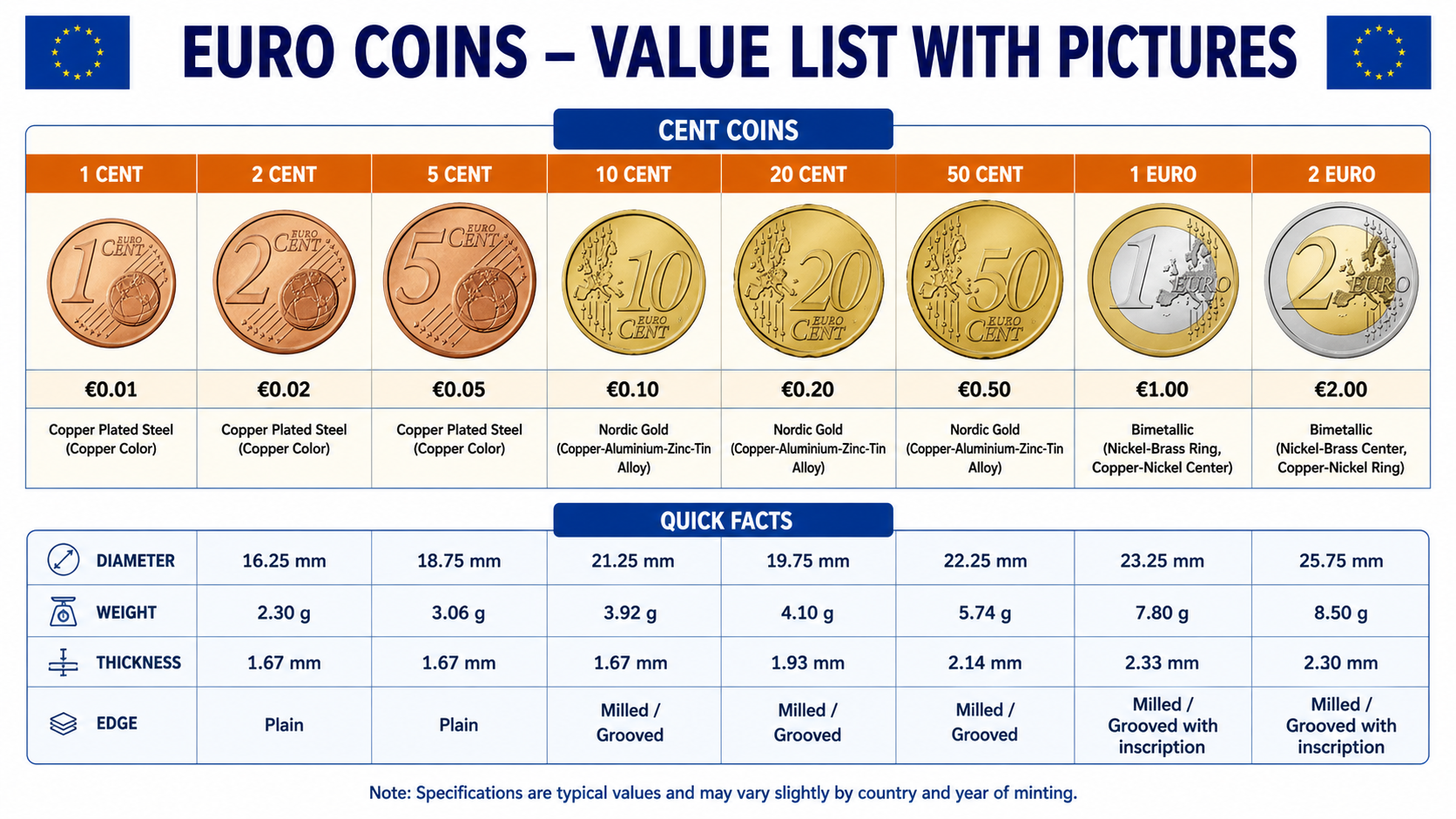
Euro Coins Value List With Pictures {#euro-coins-value-list}
Here is a full breakdown of each coin’s face value, material, and what collectors may actually pay for certain versions.
1 Cent Euro Coin
- Face Value: €0.01
- Material: Copper-plated steel
- Diameter: 16.25 mm
- Design (Common Side): Globe with Europe highlighted
- Collector Value: Most standard versions are worth face value. However, a 2002 Vatican 1 cent can fetch €50–€200.
2 Cent Euro Coin
- Face Value: €0.02
- Material: Copper-plated steel
- Diameter: 18.75 mm
- Collector Value: Standard coins = face value. A 2002 San Marino 2 cent in mint condition can be worth €30–€80.
5 Cent Euro Coin
- Face Value: €0.05
- Material: Copper-plated steel
- Diameter: 21.25 mm
- Collector Value: Usually face value. Some early Vatican issues trade at a premium.
10 Cent Euro Coin
- Face Value: €0.10
- Material: Nordic gold (copper-aluminum-zinc-tin alloy)
- Diameter: 19.75 mm
- Design: Features famous national monuments (e.g., Eiffel Tower on French coins)
- Collector Value: Face value in most cases. Special mint versions may sell for €5–€15.
20 Cent Euro Coin
- Face Value: €0.20
- Material: Nordic gold
- Diameter: 22.25 mm
- Unique Feature: “Spanish flower” edge design
- Collector Value: Mostly face value. Proof versions from small nations can reach €20+.
50 Cent Euro Coin
- Face Value: €0.50
- Material: Nordic gold
- Diameter: 24.25 mm
- Collector Value: Standard circulation: face value. Some commemorative editions are valued at €10–€50.
€1 Euro Coin
- Face Value: €1.00
- Material: Bimetallic (nickel brass + white metal)
- Diameter: 23.25 mm
- Collector Value: Most are worth €1. But a 2007 Vatican €1 in uncirculated condition can be worth €200–€400.
€2 Euro Coin
- Face Value: €2.00
- Material: Bimetallic (nickel brass outer + nickel-brass inner)
- Diameter: 25.75 mm
- Collector Value: This is where things get exciting. A 2007 Monaco €2 commemorating Grace Kelly trades for €1,500–€2,500 or more at auction.
Country-Specific Designs and Their Worth {#country-specific-designs}
Each of the 20 Eurozone countries issues its own national designs. Therefore, the same denomination from different countries can have very different collector values.
Most Sought-After Countries for Collectors
Vatican City — Only a small number of coins are minted each year. Because of this, almost every Vatican euro coin is worth significantly more than face value.
Monaco — Monaco coins are rarely used in circulation and are minted in tiny quantities. A 2001 Monaco set is considered a holy grail for euro collectors.
San Marino — Similar to Vatican and Monaco, San Marino has limited mintage numbers. Early issues from 2002 are especially valuable.
Germany — Germany issues five different €2 commemoratives every year (one per federal state). Some of these are already fetching €5–€30 above face value.
Finland and the Netherlands — Known for clean, high-quality mint coin production. Their proof sets are popular with serious collectors.
Rare Euro Coins Worth a Lot of Money {#rare-euro-coins}
If you’re wondering which specific coins could be hiding real value, here’s a shortlist of the most valuable euro coins known today:
| Coin | Year | Estimated Value |
|---|---|---|
| Monaco €2 (Grace Kelly) | 2007 | €1,500–€2,500 |
| Vatican 1 cent | 2002 | €100–€200 |
| Monaco €1 | 2001 | €300–€500 |
| San Marino €2 (Proof) | 2002 | €150–€250 |
| Luxembourg €2 (Grand Duke) | 2004 | €80–€150 |
| Greece €2 (Olympics) | 2004 | €20–€50 |
| Germany €2 (Schleswig-Holstein) | 2006 | €15–€40 |
How to Identify Valuable Euro Coins {#how-to-identify}
Finding a rare coin starts with knowing what to look for. Follow these simple steps:
- Check the national side — Look for the country of origin and the year of minting.
- Look at mintage numbers — Lower mintage = higher potential value. Vatican and Monaco coins have the lowest.
- Inspect the coin’s condition — Uncirculated or proof coins are worth far more than worn ones.
- Use a coin catalog — Tools like the Standard Catalog of World Coins or online databases like Numista.com list current euro coin values by country.
- Weigh the coin — Authentic euro coins have precise weights. Fakes often miss by a fraction of a gram.
Quick Tip: A loupe (jeweler’s magnifying glass) helps you spot mint marks, edge lettering, and fine details that distinguish common coins from rare ones.
Key Takeaways {#key-takeaways}
- There are 8 euro coin denominations, ranging from 1 cent to €2.
- Most circulation coins are worth only face value.
- Coins from Vatican City, Monaco, and San Marino are almost always worth more than face value.
- The rarest and most valuable euro coin in circulation is the 2007 Monaco €2 (Grace Kelly), worth up to €2,500.
- Coin condition, country of origin, and mintage year are the three biggest factors affecting value.
- Always cross-reference your coins with a trusted numismatic database before selling.
Conclusion
Understanding the euro coins value list with pictures can turn your spare change into a surprisingly rewarding hobby — or even a profitable one. From the humble 1 cent coin to the prestigious €2 Monaco commemorative, every coin tells a story.
The key takeaway? Don’t dismiss your euro coins as just pocket change. That €2 in your wallet might just be someone else’s treasure.
Ready to start your collection? Begin by checking every coin’s country of origin and minting year. Use Numista or a certified coin dealer to verify rare finds. And if you discover a Vatican or Monaco coin — hold onto it.
FAQs
Q1: Which euro coin is the most valuable?
The 2007 Monaco €2 coin commemorating Princess Grace Kelly is widely considered the most valuable euro circulation coin. In good condition, it can sell for €1,500 to €2,500 or more at specialist auctions.
Q2: Are old euro coins worth more money?
Not necessarily all of them. However, early-issue coins (2002) from small minting nations like Vatican City, Monaco, and San Marino can be significantly more valuable than face value because of their extremely limited production numbers.
Q3: How can I find out what my euro coin is worth?
You can use free resources like Numista.com or the official Coin Price Guide to look up individual coins by country, year, and denomination. Condition is a major factor in determining the actual market value.
Q4: Can I still use old euro coins as currency?
Yes. All official euro coins remain legal tender across Eurozone countries, regardless of age or design variation. However, selling a rare coin to a collector will almost always get you far more than its face value.
Q5: Are 2 euro coins always worth only €2?
Not at all. While most €2 coins in regular circulation are worth just €2, commemorative and proof versions — especially from low-mintage countries — can be worth dozens or even thousands of euros to the right collector.