
What if a missing letter on a coin could make it worth thousands of dollars?
That’s exactly the story of the 1922 Plain Lincoln Penny — one of the most fascinating error coins in American numismatic history. Most people toss old pennies into a jar without a second glance. But if you’re holding a 1922 Lincoln cent with no mint mark, you might be sitting on a small fortune.
This guide breaks down everything you need to know — from how the error happened to exactly how much your coin could be worth today.
Table of Contents
What Makes the 1922 Plain Lincoln Penny Special?
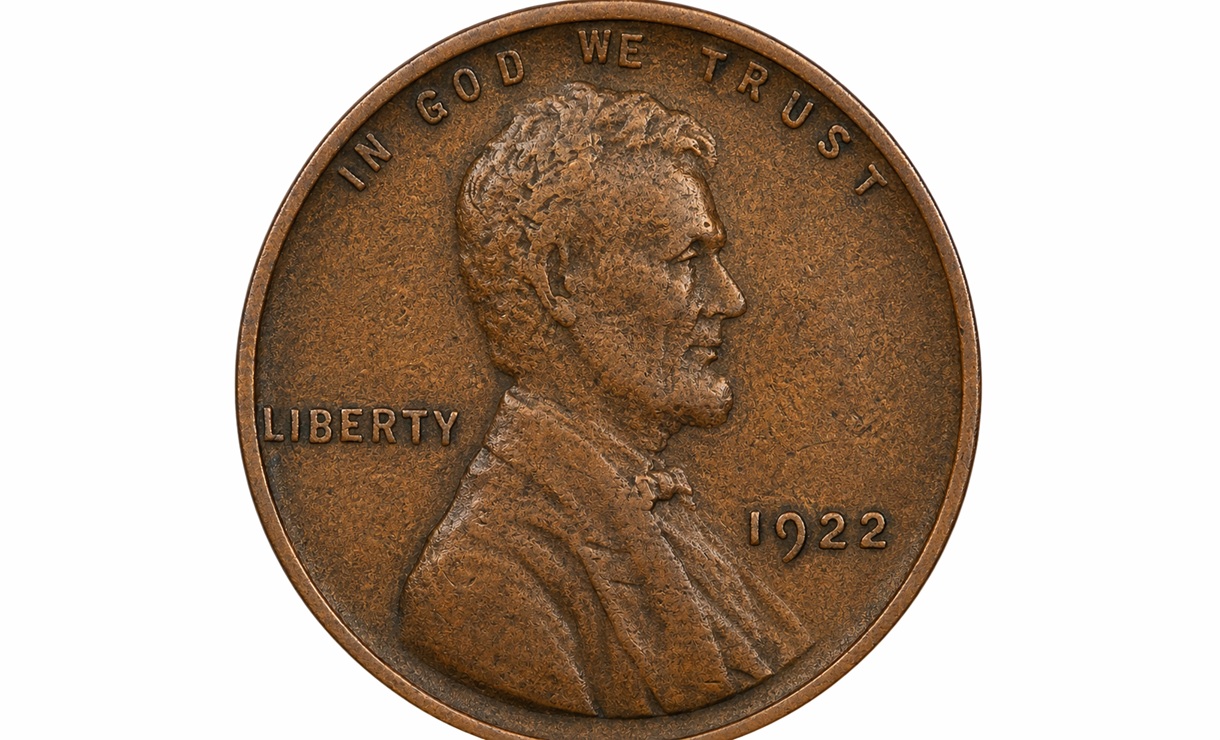
In 1922, the Philadelphia Mint did not produce any Lincoln pennies. All cents that year were struck exclusively at the Denver Mint, which normally adds a small “D” mint mark below the date.
However, due to heavily worn dies during production, some coins were struck without a visible mint mark. These became known as 1922 Plain Lincoln Pennies — and collectors have been hunting them ever since.
The absence of the “D” is not intentional. It’s a die error, and that’s precisely what makes these coins so desirable.
The History Behind the 1922 Penny
The early 1920s were a busy period for U.S. coin production. Post-World War I demand for circulating currency was high, and mint facilities were under pressure.
By 1922, the Denver Mint was the sole producer of Lincoln cents. The dies used to strike coins gradually wore down through repeated use. Some became so worn that the “D” mint mark — already a small detail — was ground away almost entirely.
Three specific die pairs are known to have produced the plain or near-plain 1922 pennies. Of these, Die Pair #2 is considered the “true” 1922 Plain, where no trace of the “D” is visible on either side of the coin.
This wasn’t caught immediately. Many of these coins entered circulation before the error was identified — which is why survivors in high grades are genuinely rare today.
How to Identify a Genuine 1922 Plain Penny
Not every faded “D” makes a coin valuable. Here’s what you need to check:
Step-by-step identification:
- Check the date — It must read “1922.” No other year applies.
- Look for the mint mark — Examine the area just below the date under magnification.
- Examine both sides — A true 1922 Plain will show a weak or missing “D” AND strong details on the reverse (Lincoln Memorial reverse didn’t exist yet — look for the wheat design).
- Check the reverse detail — On authentic examples, the reverse wheat stalks should still show clear detail despite the obverse wear.
- Use a loupe or magnifier — A 5x–10x magnifying glass is sufficient for basic examination.
Pro Tip: If the reverse is also flat and poorly detailed, the coin is likely just a heavily circulated weak-D, not the prized plain variety.
1922 Weak D vs. 1922 Plain — Know the Difference
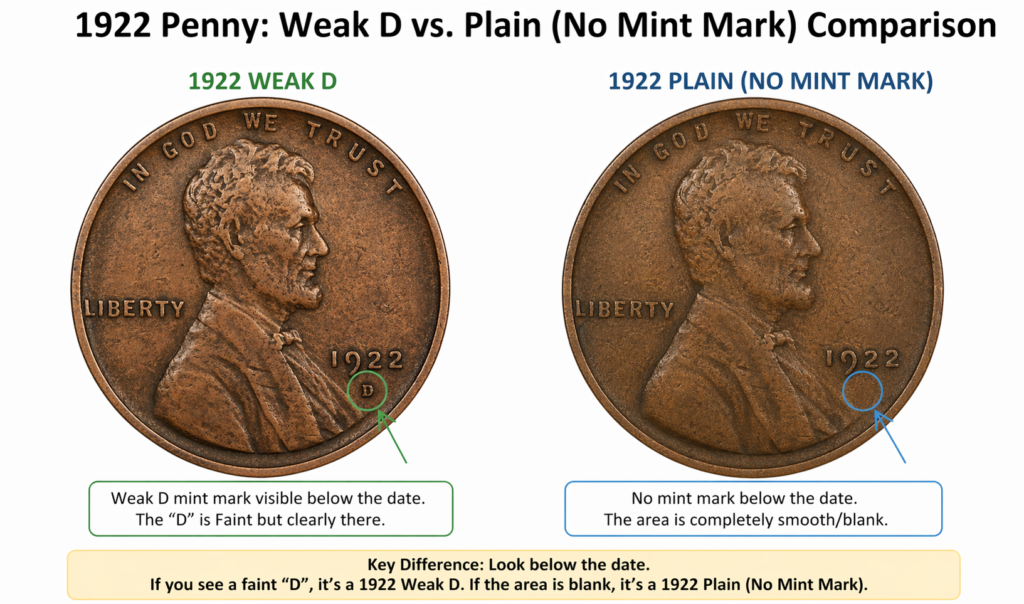
This distinction is critical for collectors and sellers alike.
| Feature | 1922 Weak D | 1922 Plain (Die Pair #2) |
|---|---|---|
| Mint Mark Visible | Faintly | Not at all |
| Reverse Detail | Weak | Strong |
| Value Range | $20–$300 | $500–$15,000+ |
| Rarity | Scarce | Very Rare |
| PCGS/NGC Designation | VDB Weak D | 1922 Plain |
The 1922 Plain Lincoln Penny specifically refers to coins from Die Pair #2 where the “D” is completely absent and the reverse retains good definition. This combination is what third-party grading services like PCGS and NGC look for before assigning the premium designation.
What Is a 1922 Plain Lincoln Penny Worth?
Value depends heavily on condition and certification.
- Good (G-4): $500 – $700
- Fine (F-12): $800 – $1,200
- Very Fine (VF-20): $1,500 – $2,500
- Extremely Fine (EF-40): $3,500 – $6,000
- About Uncirculated (AU-50): $7,000 – $12,000
- Mint State (MS-60+): $15,000 – $25,000+
In 2021, a PCGS-graded MS-64 Red-Brown example sold at auction for over $50,000 — a testament to just how rare high-grade survivors are.
Because counterfeits and altered coins exist, always check the PCGS population report for the 1922 Plain penny before buying or selling. Professional third-party grading is strongly recommended.
Key Takeaways
- The 1922 Plain Lincoln Penny is a genuine mint error, not an intentional design.
- Only coins from Die Pair #2 qualify as the true “plain” variety.
- Strong reverse detail is the key authentication marker.
- Values range from $500 in circulated grades to $50,000+ in mint state.
- Always seek third-party grading before purchasing.
Conclusion
The 1922 Plain Lincoln Penny is proof that the smallest details — or the absence of them — can make an ordinary coin extraordinary. A missing mint mark turned a routine Denver cent into one of the most valuable Lincoln penny errors ever produced.
Whether you’re a seasoned collector or someone who just found an old penny in a drawer, knowing what to look for can make all the difference.
Ready to dig deeper into rare coins worth money? Explore more guides on our site and discover what else might be hiding in plain sight — or in that forgotten coin jar.
FAQs
Q1: How many 1922 Plain Lincoln Pennies exist?
Exact population is unknown, but PCGS and NGC have certified several hundred examples across all grades. High-grade survivors are extremely rare, making this one of the most sought-after Lincoln cent varieties.
Q2: Is a 1922 penny without a mint mark always valuable?
Not necessarily. Many 1922 pennies have a weakly struck “D” that has worn away. Only coins authenticated as Die Pair #2 with no visible “D” and strong reverse detail qualify as the valuable plain variety.
Q3: Can I find a 1922 Plain penny in circulation?
It’s extremely unlikely today. Most examples have already been found and are held in collections. However, they occasionally surface in old coin hoards, estate sales, or inherited collections.
Q4: Should I clean my 1922 plain penny before selling?
Never clean a coin before selling. Cleaning destroys natural patina, drastically reduces value, and can turn a potentially high-grade coin into an ungradable one. Always sell as-found.
Q5: Where can I get a 1922 Plain Lincoln Penny authenticated?
Submit it to PCGS or browse NGC-certified Lincoln cent varieties to compare your coin against authenticated examples. Both services issue certified holders for genuine error coins.
1 thought on “1922 Plain Lincoln Penny — Why the Missing Mint Mark Makes It Valuable”