
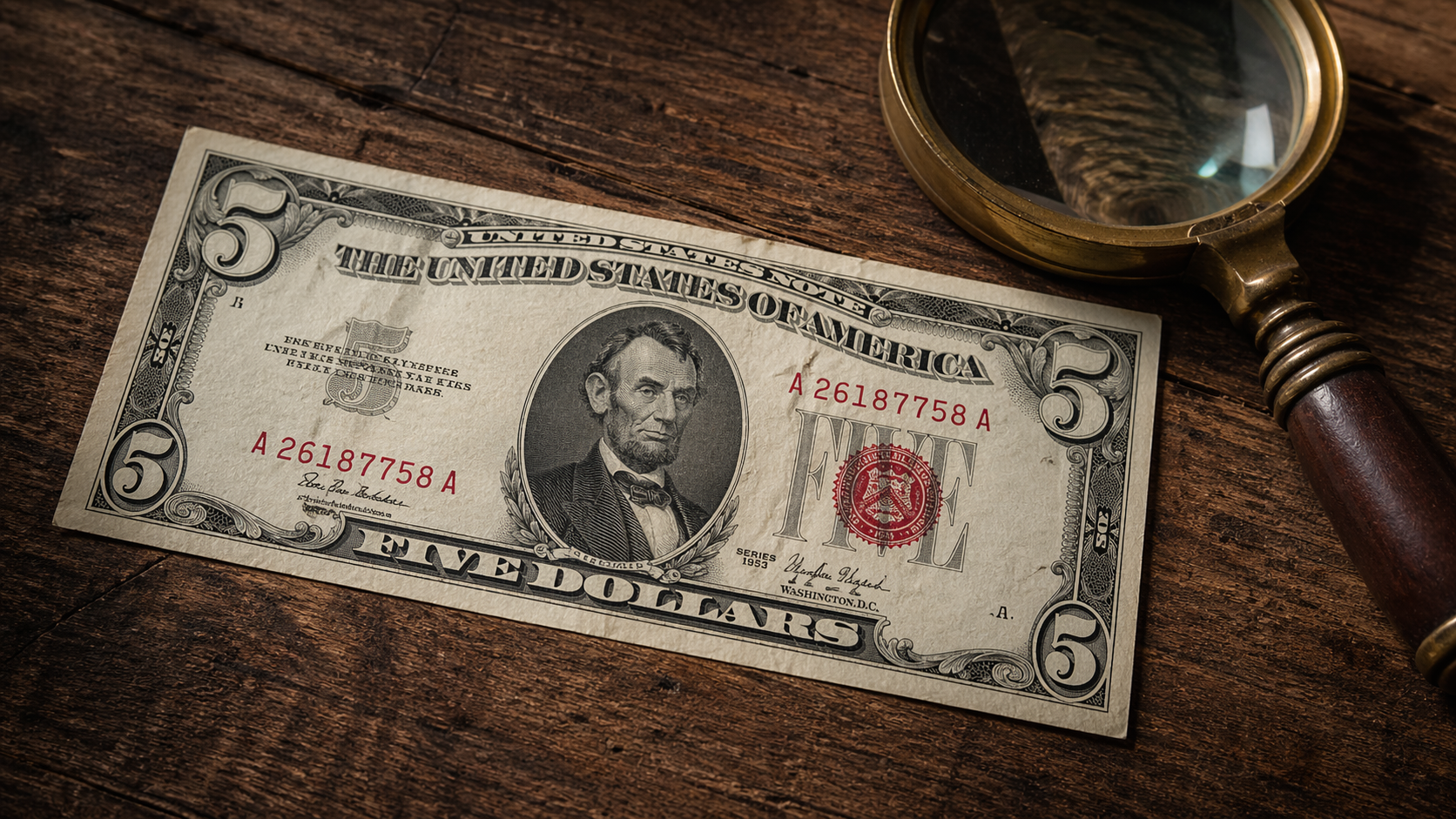
You might have a $5 bill sitting in a drawer right now — and it could be worth far more than five dollars.
The 1953 Red Seal $5 bill is one of those rare pieces of American paper money that collectors genuinely get excited about. With its bold red Treasury seal and its status as a United States Note (not a Federal Reserve Note), it stands out immediately.
But here’s the thing: not every 1953 red seal five-dollar bill is equally valuable. The specific date, series letter, and serial number on your bill can mean the difference between $10 and $500 or more.
Just like date and mint mark can make one coin worth thousands while another sits at face value, the same principle applies to rare paper currency.
This guide breaks it all down — so you know exactly what to look for.
What Is a 1953 Red Seal $5 Bill?
The 1953 Red Seal $5 bill is a United States Note, a type of currency issued directly by the U.S. Treasury rather than through the Federal Reserve system. You can identify it immediately by the red seal and red serial numbers on the front.
These notes were printed in four main series:
- 1953 (no letter)
- 1953A
- 1953B
- 1953C
Each series was printed in different quantities. Some are plentiful. Others are scarce — and scarcity drives value.
1953 Red Seal $5 Bill Value by Series
1953 (No Letter)
This is the base series. Circulated examples in average condition typically sell for $8–$15. However, uncirculated (crisp, never-folded) notes can fetch $30–$75, and star notes push well above that.
1953A
The 1953A series is slightly more common than the base issue but still holds solid collector value. Expect $10–$20 in circulated grades, and up to $60–$100 for gem uncirculated examples.
1953B
This series was printed in smaller numbers than the 1953 and 1953A. In top condition, a 1953B five-dollar red seal note can command $50–$150 from serious collectors.
1953C
The 1953C is the rarest of the four series. Circulated notes sell reliably for $20–$40, while pristine uncirculated notes regularly sell for $100–$200+. This is the one to watch for.
Serial Numbers That Add Real Value
Most collectors know that condition matters — but serial numbers can multiply a bill’s value dramatically.
Fancy serial numbers work similarly to doubled die errors — both are production anomalies that collectors pay serious premiums for.
Here are the serial number types to look for on your 1953 Red Seal $5 bill:
⭐ Star Notes Star notes have a small star (★) at the end of the serial number. They were printed as replacements when a note was damaged during production. Star notes are rarer than standard notes and typically worth 2x to 4x the standard value.
Low Serial Numbers Bills with serials like A00000001A through A00001000A are considered “low serials” and attract premium bids. The lower the number, the higher the demand.
Solid Serial Numbers A note where every digit is the same — like A33333333A — is called a solid serial. These are extremely rare and can sell for $500 to $1,000+ regardless of the denomination.
Ladder Serial Numbers A ladder serial runs consecutively: A12345678A. Collectors prize these for their visual appeal. Expect premiums of $100–$300 over face value.
Repeating Pairs / Bookends Numbers like A12121212A or A10000001A also attract attention from specialty collectors.
How to Check Your Bill’s Condition
Condition is graded on the Sheldon scale, commonly called PMG or PCGS grades for paper money:
- Very Fine (VF-20 to VF-35): Light folds, still attractive
- Extremely Fine (EF-40/45): Minimal folds, sharp corners
- About Uncirculated (AU-50/55): Barely handled, near-perfect
- Gem Uncirculated (MS-65/66): Never folded, no handling marks
A 1953C red seal in Gem Uncirculated with a star note serial? That’s a bill that could realistically bring $300–$600 at auction.
Quick Insights: Why This Bill Still Matters
- Red Seal United States Notes were discontinued in 1971, making every surviving example part of a closed chapter in American monetary history.
- The 1953 series represents the last widely circulated red seal $5 notes most Americans ever handled.
- With inflation and growing interest in numismatics, values for top-grade examples have risen steadily since 2010.
- These bills are accessible entry points for new collectors — you don’t need to spend thousands to start.
Where to Sell a 1953 Red Seal $5 Bill
If you’ve confirmed your note has value, consider these options:
- eBay — The largest marketplace for currency. Search completed listings to see real-world prices.
- Heritage Auctions — Best for high-grade or rare serial number notes.
- Local coin dealers — Quick cash, but typically 30–50% below retail.
- PMG or PCGS grading — Consider getting top-grade notes professionally graded before selling. It adds credibility and often increases sale price significantly.
Key Takeaways
- The 1953C series is the rarest and most valuable of the four 1953 Red Seal $5 bill types.
- Star notes and fancy serial numbers (solids, ladders, low serials) can dramatically increase value.
- Condition matters enormously — a gem uncirculated note is worth 5–10x a circulated one.
- Most circulated examples sell for $10–$40, but exceptional notes can reach $200–$600+.
- These bills were discontinued in 1971 — every one that survives is historically significant.
Conclusion
The 1953 Red Seal $5 bill is a fascinating piece of American currency history — and potentially a valuable one sitting right in your collection.
Focus on the series letter (1953C is the rarest), inspect the serial number for stars or fancy patterns, and assess condition carefully. Those three factors together tell you whether you’re holding a $10 bill or a $500 collector’s prize.
The numismatic world rewards those who know what to look for — whether it’s a rare error coin or an old banknote with the right serial number.
If you think you have a valuable note, don’t spend it — get it graded and sell it right.
FAQs
Q1: What makes a 1953 Red Seal $5 bill rare?
Rarity comes from a combination of series (1953C is scarcest), condition (uncirculated is rarer), and serial number type (stars, solids, ladders). A bill with multiple rare traits can be worth hundreds of dollars.
Q2: How do I know if my $5 red seal note is a star note?
Look at the serial number on the front of the bill. If there is a small ★ symbol at the end of the number, you have a star note — and it’s worth more than a standard issue.
Q3: Are all 1953 red seal $5 bills valuable?
Not all. Heavily circulated notes in poor condition may only bring $8–$15. Value jumps significantly for uncirculated grades and special serial numbers. Always assess condition first.
Q4: Where can I get my 1953 Red Seal $5 bill appraised?
Reputable options include PMG, PCGS, local coin dealers, or established platforms like Heritage Auctions and Stack’s Bowers.
Q5: Is the 1953 Red Seal $5 bill legal tender?
Yes. However, its collector value almost always exceeds face value — so spending one would be a costly mistake.