
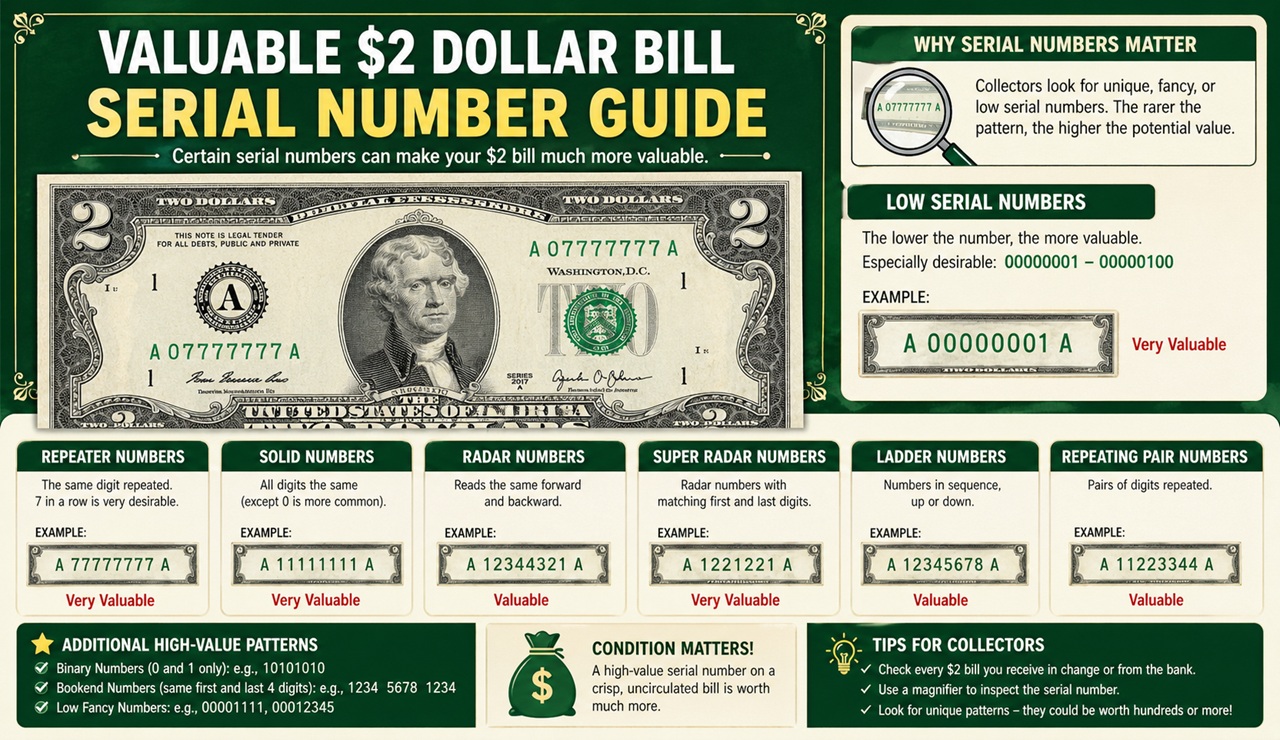
That crumpled $2 bill sitting in your wallet might be worth far more than face value. In fact, some $2 bills have sold for hundreds — even thousands — of dollars at auction. The secret? The serial number.
Knowing how to tell if your old $2 bill has a valuable serial number could turn pocket change into a serious payday. This guide breaks down exactly what to look for.
Table of Contents
- Why $2 Bills Are Collectible
- What Makes a Serial Number Valuable?
- Types of Fancy Serial Numbers to Look For
- How to Check Your $2 Bill’s Value
- Other Factors That Affect Value
- Key Takeaways
- FAQs
Why $2 Bills Are Already Special
According to the U.S. Bureau of Engraving and Printing, $2 bills are still actively printed but in far smaller quantities than other denominations.
Because of this scarcity, collectors have always been drawn to them. However, not every $2 bill is valuable. The serial number is often the single biggest factor that separates a $2 bill worth $2 from one worth $2,000.
What Makes a Serial Number Valuable?
Serial numbers on U.S. currency are 8-digit codes printed in green ink on Federal Reserve Notes. To a collector, certain number patterns — called “fancy serial numbers” — signal rarity and desirability.
The rarer the pattern, the higher the demand. Therefore, currency collectors actively hunt through their bills looking for these special combinations.
Here’s a quick answer for featured snippet purposes:
A $2 bill has a valuable serial number if it features a pattern like all repeating digits, low numbers (00000001–00000100), radar numbers (reads the same forwards and backwards), ladders (12345678), or solid digits. These “fancy” serial numbers can make a $2 bill worth $500 to $4,500 or more to collectors.
Types of Fancy Serial Numbers to Look For
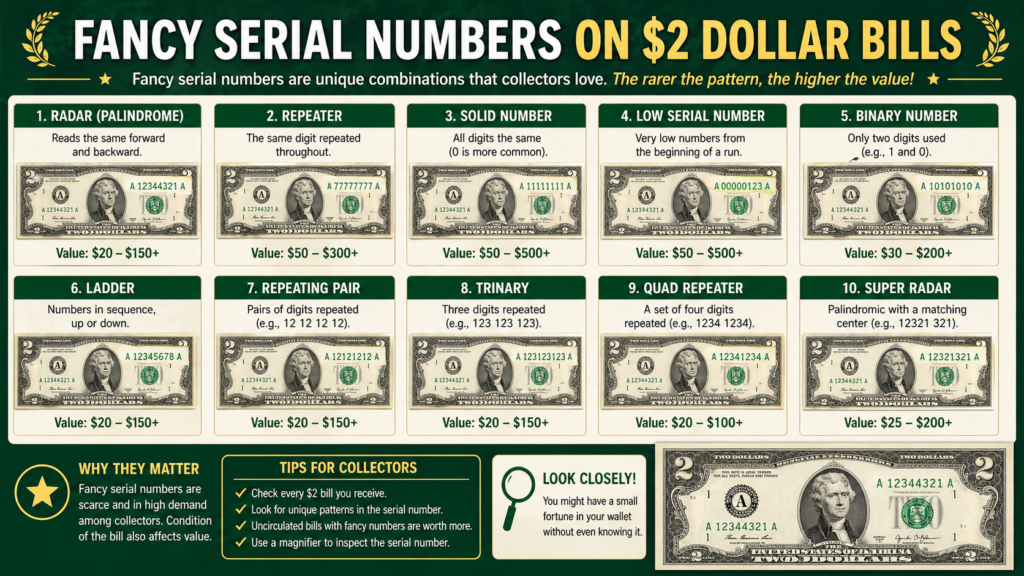
This is where things get exciting. There are several distinct categories of valuable serial numbers on $2 bills.
1. Low Serial Numbers
Bills numbered 00000001 through 00000100 are considered ultra-low. The lower the number, the higher the value. A $2 bill with serial number 00000001 is essentially a collector’s holy grail.
2. Radar Numbers
A radar serial number reads the same forwards and backwards. For example: 12344321 or 09800890. These are also called palindrome notes and are highly sought after.
3. Repeater Numbers
Repeaters follow a pattern where a sequence repeats itself, such as 12341234 or 56785678. They’re less rare than radars but still command a premium.
4. Solid or Near-Solid Numbers
A solid serial number contains all the same digit — like 33333333 or 77777777. These are extremely rare and can sell for thousands. Near-solids (seven of eight digits matching) are also valuable.
5. Ladder Numbers
A ladder goes up or down in perfect sequence: 12345678 or 87654321. These are among the most dramatic-looking fancy notes and fetch strong prices.
6. Binary Notes
Binary serial numbers use only two different digits, such as 10101010 or 11001100. They’re not as rare as solids, however they still attract collector interest.
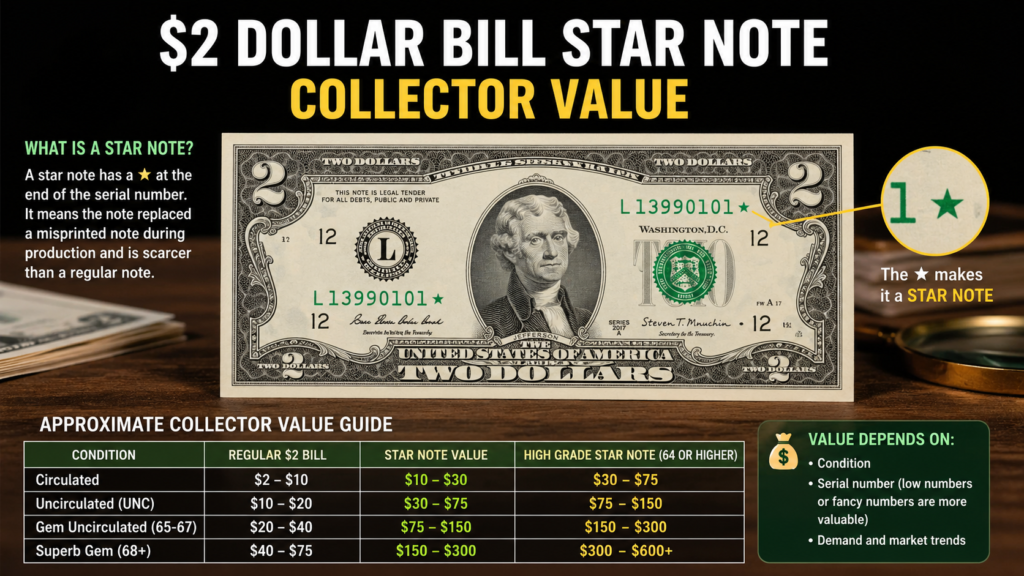
7. Star Notes
Look for a star symbol (★) at the end of the serial number. Star notes are replacement bills printed when a regular note is damaged during production. On $2 bills especially, star notes from certain years and Federal Reserve districts are exceptionally scarce.
How to Check Your $2 Bill’s Value
Once you’ve spotted a potentially fancy serial number, here’s how to verify its worth:
- Visit CoolSerialNumbers.com — The easiest way to rate your note is by using this free fancy serial number checker tool trusted by currency collectors worldwide
- Check eBay sold listings — Search your serial number type under “sold” results to see real transaction prices.
- Use the PMG or PCGS currency grading guides — For certified value, submit your bill using this professional currency grading guide from PMG, one of the most trusted names in paper money authentication.
- Post in collector forums — Communities like the Paper Money Forum have experts who can appraise your note quickly.
Other Factors That Affect Your $2 Bill’s Value
The serial number matters most, but other elements also influence price:
- Year of issue — $2 bills from 1890, 1928, and 1953 are older series and naturally rarer.
- Condition (grade) — An uncirculated bill in crisp condition is always worth more.
- Federal Reserve District — Some districts printed far fewer $2 bills than others.
- Printing errors — Misaligned printing, ink smears, or double impressions dramatically increase value. This is similar to how error coins like the 2004 Wisconsin State Quarter extra leaf became some of the most talked-about collectibles in recent memory.
Quick Insight: What Year $2 Bills Are Worth the Most?
Series years 1928, 1953, and 1963 are generally the most desirable for age-based value. However, a modern 2017 $2 bill with a solid serial number will outprice a worn 1953 bill every time. Condition and serial number pattern together determine peak value.
Key Takeaways
- Fancy serial numbers — radars, ladders, solids, and low numbers — are the #1 driver of $2 bill collector value.
- Star notes on $2 bills are especially rare and worth checking.
- Use free tools like CoolSerialNumbers.com to rate your serial number.
- Condition and year both matter, but serial number pattern often matters more.
- Some $2 bills have sold for over $4,500 based on serial number alone.
Conclusion
Your old $2 bill might be hiding a small fortune in plain sight. Now that you know how to tell if your $2 bill has a valuable serial number, take five minutes to flip through your wallet, check your junk drawer, and look through any old cash you’ve set aside.
The difference between a $2 bill and a $2,000 bill is often just a pattern — and now you know exactly what to look for.
FAQs
Q1: What serial numbers make a $2 bill valuable? Serial numbers that form patterns — such as all repeating digits, palindromes (radars), sequential ladders, or very low numbers like 00000001 — are considered fancy and highly collectible. These rare $2 bill serial numbers can be worth hundreds to thousands of dollars.
Q2: Is a star note $2 bill worth more? Yes. Star notes are replacement bills and are printed in much smaller quantities. A $2 star note in uncirculated condition, especially from certain Federal Reserve districts or years, can be worth significantly more than a standard note.
Q3: How do I find out what my $2 bill is worth? Check the serial number pattern at CoolSerialNumbers.com, then compare with sold eBay listings. For a certified valuation, consider submitting your bill to PMG (Paper Money Guaranty) or PCGS Currency.
Q4: Are all old $2 bills valuable? Not automatically. Age helps, but a worn 1928 $2 bill in poor condition may be worth only $10–$20. Meanwhile, a 2003 $2 bill with a radar serial number could fetch far more. Condition and serial number matter most.
Q5: What is the most valuable $2 bill ever sold? Certain $2 bills with ultra-low serial numbers and perfect uncirculated grades have sold for over $4,500. Bills with printing errors, like those seen in valuable error currency, can push even higher depending on collector demand at auction.