
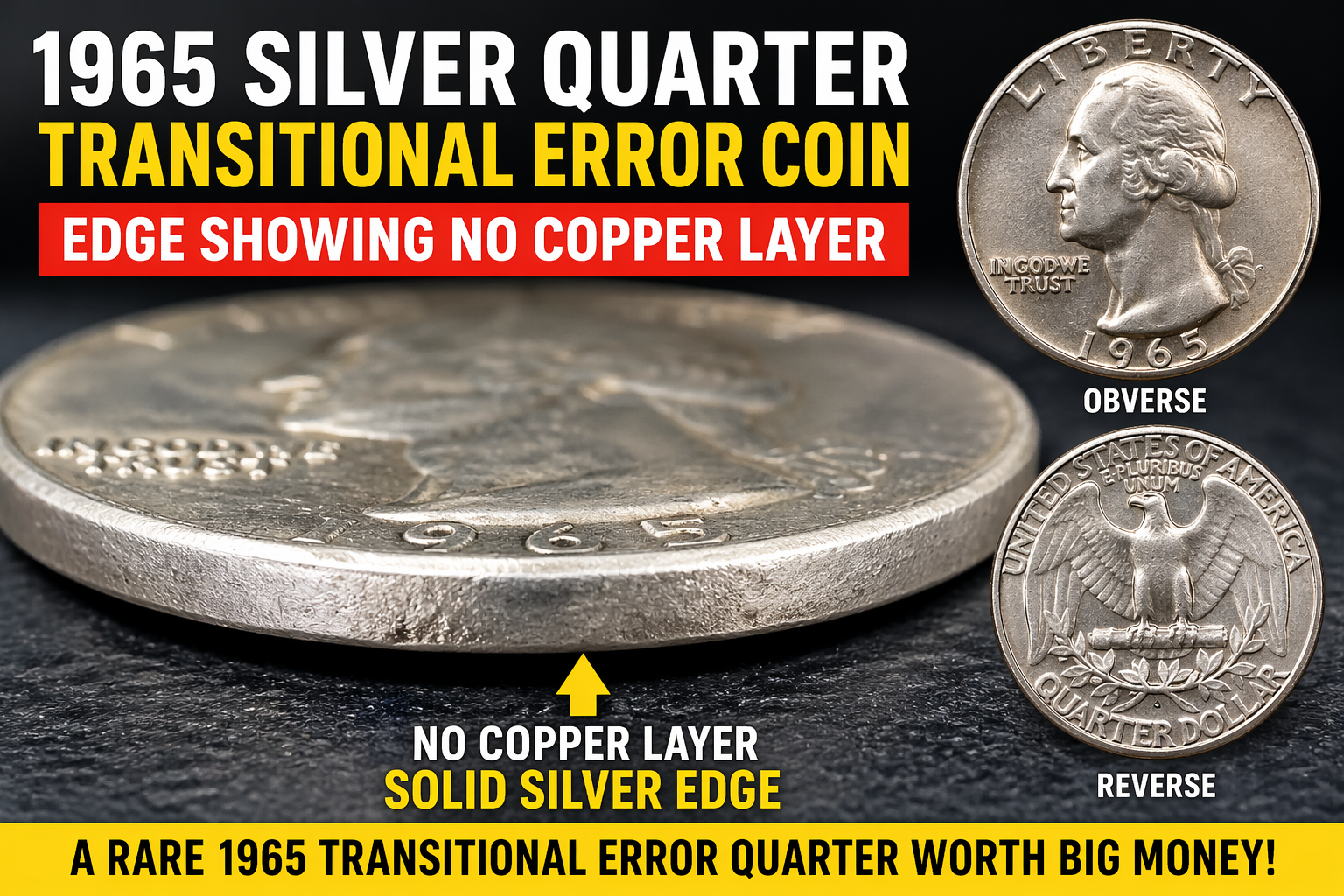
Most people would toss a 1965 quarter into a parking meter without a second thought. But what if that coin was worth $7,000 — or more?
The 1965 silver quarter is one of the most sought-after transitional error coins in American numismatic history. Much like the most famous rare coins in American history, it rewards collectors who know exactly what to look for. It was born from a dramatic moment in U.S. monetary policy — a moment when the government quietly stripped silver from everyday coinage. A handful of 1965 quarters slipped through the system still struck on 90% silver planchets. Those coins are now worth a small fortune.
In this guide, you’ll learn exactly what makes the 1965 silver quarter so rare, how to test if you have one, and what these coins sell for today.
What Is the 1965 Silver Quarter Error Coin?
The 1965 silver quarter is a rare transitional error coin struck on a 90% silver planchet instead of the clad copper-nickel composition introduced that year. These coins were accidentally produced during the U.S. Mint’s switch away from silver coinage, making them extremely scarce and highly valuable to collectors — often selling for thousands of dollars.
In 1965, the United States made a historic change to its coinage. The Coinage Act of 1965 eliminated silver from dimes and quarters entirely, replacing them with a copper-nickel clad composition. The main reason? Soaring silver prices were making coins more valuable as raw metal than as currency.
During the transition, some old silver planchets — the blank discs used to stamp coins — remained in the production pipeline. A small number of 1965 quarters were accidentally struck on these leftover 90% silver planchets. The result is what numismatists call a transitional error coin.
These aren’t counterfeit coins. They are genuine U.S. Mint products — just made with the wrong material. That distinction is exactly what makes them so desirable.
Why Is the 1965 Silver Quarter So Rare?
Rarity in coin collecting comes down to numbers. Standard 1965 quarters were minted in the billions — over 1.8 billion from Philadelphia alone. Therefore, finding one with the silver composition requires remarkable luck.
The Perfect Storm of Rarity
- Limited window: Silver planchets were only available during a brief transitional period in 1964–1965.
- No mint mark: The 1965 quarters carry no mint mark by law, making attribution rely entirely on metal composition testing.
- Survival rate: Most silver error coins were likely spent, melted, or lost before collectors recognized their value.
The U.S. Mint was also under strict pressure to eliminate silver coinage as fast as possible. Oversight was intense. That means the number of silver planchets that accidentally entered the 1965 production run was extremely small — likely just dozens, possibly fewer.
Today, only a handful of certified 1965 silver quarters are known to exist. Each confirmed example goes through professional grading services to authenticate the silver content.
How to Identify a 1965 Silver Quarter
Identifying a 1965 silver quarter is both an art and a science. You cannot tell by looking alone — however, there are reliable methods to test one.
Visual Clues (First Step)
- Check the coin’s edge: a clad quarter shows a visible copper layer; a silver quarter’s edge is uniformly silver-gray.
- Look at the overall color: silver quarters often have a slightly different, brighter luster than clad coins.
- Weigh the coin: a 90% silver quarter weighs 6.25 grams; a standard clad quarter weighs 5.67 grams.
Definitive Testing Methods
Visual inspection is only a starting point. To confirm silver content, use one or more of these approaches:
- Weigh it precisely: Use a jeweler’s scale accurate to 0.01g. Silver: 6.25g vs. Clad: 5.67g.
- Edge inspection: No copper stripe on the edge means silver composition.
- Specific gravity test: Silver has a higher density (10.49 g/cm³) than the clad alloy.
- Professional grading: Submit to PCGS or NGC — always get it professionally graded for definitive authentication and slabbing.
What Is a 1965 Silver Quarter Worth?
The value of a 1965 silver quarter depends heavily on its condition and, most importantly, professional certification. Here’s a general value guide:
| Grade / Condition | Estimated Value | Notes |
|---|---|---|
| Ungraded / Raw | $1,500 – $3,000 | If edge test is clear; no certification |
| VF-30 (Graded) | $3,000 – $5,000 | PCGS/NGC certified; circulated |
| MS-63 (Mint State) | $6,000 – $9,000 | Certified uncirculated; sharp strike |
| MS-65+ (Gem) | $10,000+ | Top-tier specimens; auction record |
A confirmed MS-65 example once sold at auction for over $13,000. Prices continue to climb as more collectors discover this rare error coin and fewer certified examples appear on the market.
Quick Test: Do You Have a Silver Quarter?
Here’s a simple at-home checklist you can run through in minutes. If all three markers point to silver, submit the coin to a professional grading service immediately.
- ✔ Date reads exactly 1965 (no mint mark)
- ✔ Edge shows no copper layer — fully silver-gray
- ✔ Weight is 6.25 grams on a precise scale (±0.05g tolerance)
- ✔ Coin looks distinctly brighter or “whiter” than your other quarters
Do not clean the coin. Cleaning destroys collector value and makes professional grading nearly impossible. Handle the coin by its edges only.
Why the 1965 Silver Quarter Matters to Collectors
Error coins occupy a special place in numismatics. They are accidents of history — physical proof that a major transition took place and didn’t go perfectly according to plan.
The 1965 silver quarter belongs in the same conversation as the most dramatic minting errors in U.S. history — coins that prove production mistakes can be worth a fortune. For nearly two centuries, Americans carried silver in their pockets. The Coinage Act of 1965 ended that tradition overnight. These transitional error coins are tangible artifacts of that pivotal moment.
For that reason, demand among advanced collectors — and institutions — remains exceptionally strong. Organizations like the Professional Coin Grading Service (PCGS) maintain population reports showing just how few certified examples exist.
Whether you’re a seasoned numismatist or just discovered a suspicious quarter in an old jar, understanding this coin’s story is the first step toward recognizing its true worth.
- The 1965 silver quarter is a genuine U.S. Mint transitional error coin struck on a 90% silver planchet.
- It was created when leftover silver blanks accidentally entered the new clad coin production in 1965.
- Identifying one requires edge inspection, precise weight testing, and ideally professional grading.
- Certified examples are worth anywhere from $3,000 to over $10,000 depending on condition.
- Only a small number of verified 1965 silver quarters are known to exist — making each find extraordinary.
Frequently Asked Questions
Conclusion
The 1965 silver quarter is more than just a rare coin — it’s a piece of American monetary history. It exists because of a perfect, accidental storm: the end of silver coinage, a rushed transition, and a few silver planchets that slipped through the cracks.
If you find a 1965 quarter that passes the edge test and weighs 6.25 grams, treat it with extreme care. Get it professionally graded. And understand that you may be holding something worth thousands of dollars in the palm of your hand.
The world of transitional error coins rewards those who pay attention. Start by checking your own coin collection — you never know what might be hiding there.
Think You Found a 1965 Silver Quarter?
Don’t wait — get your coin professionally graded before it loses value from improper handling.
Learn How to Submit Your Coin →
2 thoughts on “1965 Silver Quarter: Why This Transitional Error Coin Sells for Thousands”