
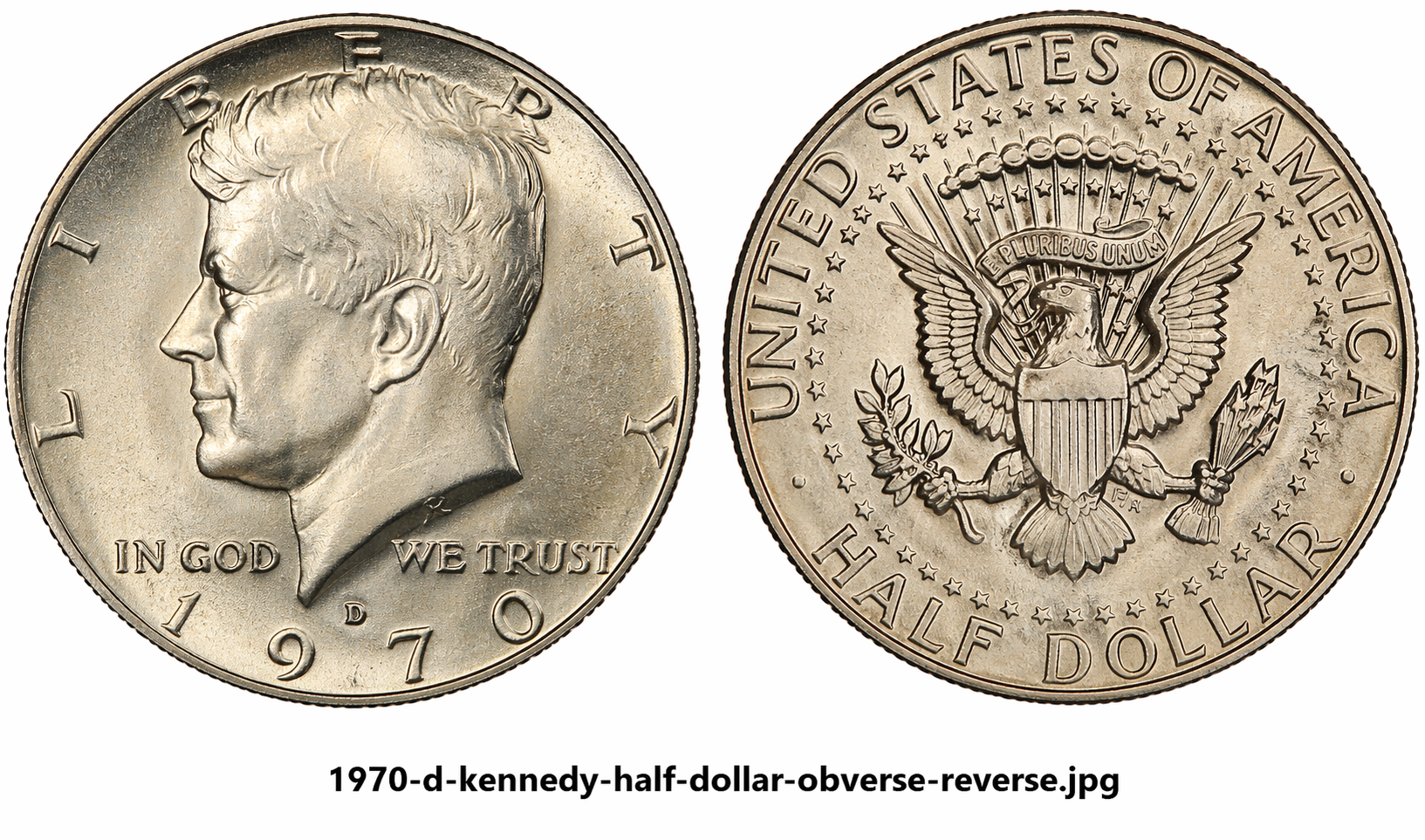
Imagine reaching into your pocket and flipping a coin worth hundreds of dollars — then dropping it in a vending machine. It happens more than you’d think. The 1970-D Kennedy Half Dollar is one of those quietly rare coins hiding in plain sight, and most people have no idea what it’s actually worth.
If you’ve ever wondered whether old half dollars are valuable, this one deserves a very close look.
Table of Contents
- What Is the 1970-D Kennedy Half Dollar?
- Why Is It So Rare?
- 1970-D Half Dollar Value: What’s It Worth Today?
- How to Identify a 1970-D Kennedy Half Dollar
- Key Varieties and Errors to Know
- Key Takeaways
- FAQs
- Conclusion
What Is the 1970-D Kennedy Half Dollar?
The 1970-D Kennedy Half Dollar is a 50-cent coin struck at the Denver Mint in 1970. It features the iconic portrait of President John F. Kennedy on the obverse and the Presidential Seal on the reverse — a design that has appeared on half dollars since 1964.
What makes the 1970-D special isn’t its design. It’s its limited distribution.
Unlike most coins struck for general circulation, the 1970-D half dollar was only released in Mint Sets — not through banks or registers. That means the average person never encountered one through normal spending. Yet somehow, many of these coins escaped into the wild over the decades.
Why Is the 1970-D Kennedy Half Dollar So Rare?
In 1970, the U.S. Mint made a key decision: half dollars would no longer enter general circulation. They were only included in annual Uncirculated Mint Sets sold directly to collectors.
The Denver Mint produced approximately 2.15 million 1970-D half dollars. That sounds like a lot — until you compare it to billions of pennies or quarters made that same year.
Because they were sealed in collector sets, many stayed untouched for decades. However, sets were sometimes broken apart, coins were spent accidentally, or they were passed along unknowingly in coin jars and estate collections.
The result? A coin that’s technically “in circulation” but extraordinarily hard to find.
1970-D Half Dollar Value: What’s It Worth Today?
Here’s the part that surprises most people.
| Condition | Estimated Value |
|---|---|
| Circulated (Good–Fine) | $3 – $10 |
| Uncirculated (MS-60) | $15 – $30 |
| Gem Uncirculated (MS-65) | $50 – $100+ |
| MS-67 or higher (PCGS/NGC graded) | $200 – $500+ |
A standard 1970-D in average uncirculated condition is worth 10–20x its face value. But high-grade specimens certified by PCGS or NGC can fetch serious money at auction.
The key driver of value is condition. Since these coins were never meant for everyday use, any wear or contact marks significantly reduce their worth. A pristine, original-luster example is the holy grail for collectors of this date.
How to Identify a 1970-D Kennedy Half Dollar
Spotting one is easier than you think — if you know what to look for.
Step-by-step identification:
- Check the denomination — It’s a 50-cent piece, larger than a quarter.
- Look at the date — The year “1970” should appear on the obverse, below Kennedy’s portrait.
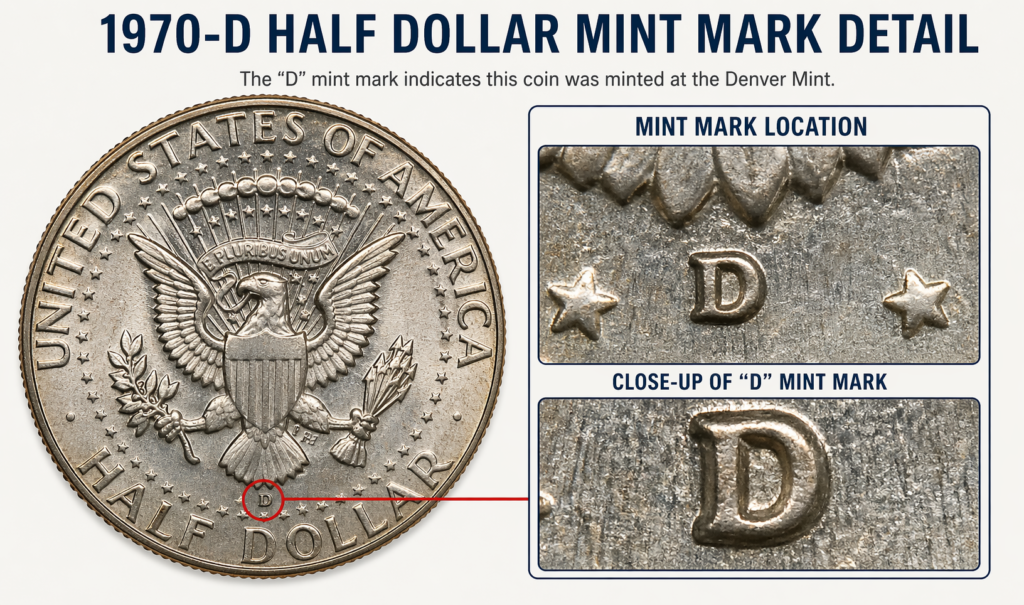
- Find the mint mark — Look for a small “D” just above the date. That’s the Denver Mint mark.
- Examine the edge — The 1970-D has a clad composition (copper-nickel over copper), so the edge shows a copper stripe.
- Assess the condition — No wear on the hair details and cheekbones means higher grade and higher value.
A loupe or magnifying glass (10x) makes this inspection much easier.
Key Varieties and Errors to Know
Like many coins from this era, the 1970-D Kennedy Half Dollar has a few notable varieties that command premium prices.
Double Die Obverse (DDO) Some 1970-D examples show doubling on Kennedy’s portrait — particularly around the lettering “LIBERTY” and the date. This is a mint error caused by a misaligned hub during die production. Similar to the well-documented 1969-S Kennedy Half Dollar Double Die, these doubled varieties carry significant collector premiums.
SMS-Like Coins A small number of 1970-D half dollars show unusually sharp strikes and mirror-like fields, resembling Special Mint Set (SMS) coins. These are highly sought after and worth having professionally graded.
Die Clashes Die clash errors — where obverse and reverse dies strike each other without a planchet between them — occasionally appear on 1970-D halves. These leave ghost images of the opposite side impressed on the coin.
Why This Coin Matters to Collectors
The 1970-D sits at a crossroads of history and scarcity. It was struck during a transitional period in U.S. coinage — similar in spirit to the 1965 silver quarter transition — when the Mint was shifting away from coins meant for everyday spending.
That context makes it more than just a collectible. It’s a snapshot of American monetary history.
For anyone building a Kennedy half dollar date set, the 1970-D is one of the most challenging pieces to acquire in top grade. Completing a set without it is simply not possible.
Key Takeaways
- The 1970-D Kennedy Half Dollar was never released for general circulation — only in Mint Sets.
- Denver Mint produced roughly 2.15 million pieces, making it scarcer than most half dollars.
- Value ranges from $3 in circulated condition to $500+ in gem grades.
- Watch for doubled die errors and die clash varieties that add significant premium.
- Always have high-grade examples certified by PCGS or NGC before selling.
Conclusion
The 1970-D Kennedy Half Dollar proves that valuable coins don’t always look flashy or ancient. Sometimes they look exactly like the change rattling around in your junk drawer.
Because it was only issued through collector Mint Sets, this coin slipped through history quietly — and many specimens have been spent, lost, or forgotten. That scarcity is exactly what makes it worth hunting for today.
Whether you’re a seasoned numismatist or just starting to explore the world of rare coins worth money, the 1970-D is a must-know date. Check your half dollars. Check old coin collections passed down from relatives. You may be sitting on more than 50 cents.
Ready to dig deeper into rare American coins? Explore our guides on the 1955 Double Die Penny and 1953 Red Seal $5 Bill — two more hidden treasures most people overlook.
FAQs
Q1: How many 1970-D Kennedy Half Dollars were made?
The Denver Mint struck approximately 2,150,000 examples in 1970. All were distributed through Uncirculated Mint Sets — not through banks — making them much harder to find than typical circulation coins.
Q2: Is the 1970-D half dollar made of silver?
No. The 1970-D is a clad coin composed of copper-nickel layers over a pure copper core. Silver Kennedy half dollars were last made for circulation in 1969 (with 40% silver content). The 1970-D contains no silver.
Q3: Where can I sell a 1970-D Kennedy Half Dollar?
You can sell through reputable coin dealers, auction platforms like Heritage Auctions or GreatCollections, or online marketplaces like eBay. For high-grade coins, consider getting a PCGS or NGC certification first to maximize your sale price.
Q4: What’s the most valuable 1970-D half dollar ever sold?
PCGS MS-67 examples have sold at auction for over $400–$500. Coins with major errors like doubled dies can command even more, depending on the severity of the variety and overall eye appeal.
Q5: How do I know if my 1970-D half dollar is in uncirculated condition?
Look for original mint luster — a cartwheel-like sheen across the coin’s surface. No flat spots, scratches, or wear on Kennedy’s hair and cheekbones. The coin should look essentially the same as the day it left the Mint.
1 thought on “1970-D Kennedy Half Dollar: The Rare Coin Most People Accidentally Spend”